Magic Lantern | Johann Falk
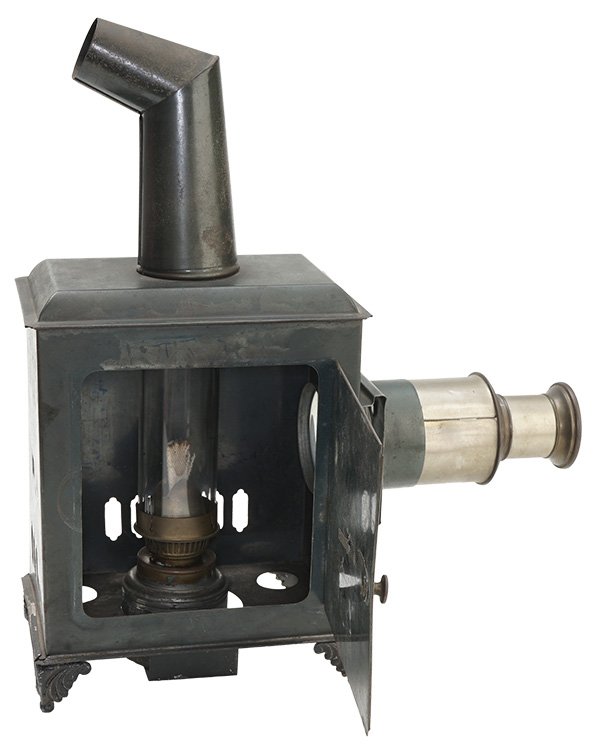
Magic lanterns existed long before photography. It basically consists of a lamp as a light source, a parabolic mirror behind it and a set of lenses in front of it. To dissipate the heat, it needs a chimney and because of the heat, they are usually made of metal.
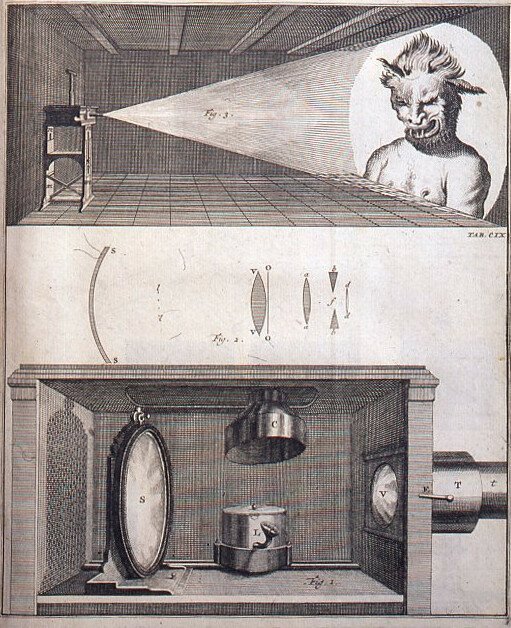
Page from Willem’s Gravesande’s book, 1720
–
The basic layout is shown in the illustration above. The mirror S has the function of harnessing the light that would go to the back of the box and simulating, with its parabolic shape, that it comes from the lamp towards the condenser V. The chimney is just above the flame. There is usually a glass tube that insulates the flame and directs its hot air. In front of the condenser are placed the transparencies that will be projected onto a screen by a lens which, in better quality Magic Lanterns, was a Petzval because of its brightness.
The first known description of a magic lantern dates back to 1659. There is no known source describing the device before then. But he didn’t advertise his invention at all. He used his Magic Lantern only for projections in his inner circle. In 1677, the German Johan Kohlans published a description, but he did so in Hebrew, Greek and Latin, so that it would only be available to wise people. It is suspected that this was out of fear of being accused of some kind of witchcraft. The idea that a physical manifestation, such as an image projected with light, could only have a physical origin, was not very well established. Linking these phenomena to manifestations beyond the material world was very easy in those days.
In this direction of spirits and other worlds manifestation, comes the fact that when the device first became widespread, it wasn’t called a magic lantern, but a fear lantern. It was certainly used by many to frighten and perhaps scam the more naive.
Impact of photography
After this wilder or more folkloric phase of the Magic Lantern, with the invention of photography, Ernst Wilhelm (William) and Friedrich (Frederick) Langenheim in Philadelphia in 1848, invented a process called Hyalotype (from the Greek, printing on glass). Immediately, the potential of projection was exploited for education, entertainment and presentations in general, just as we do today with digital media and things like Power Point.
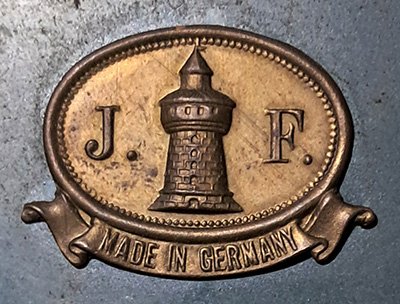
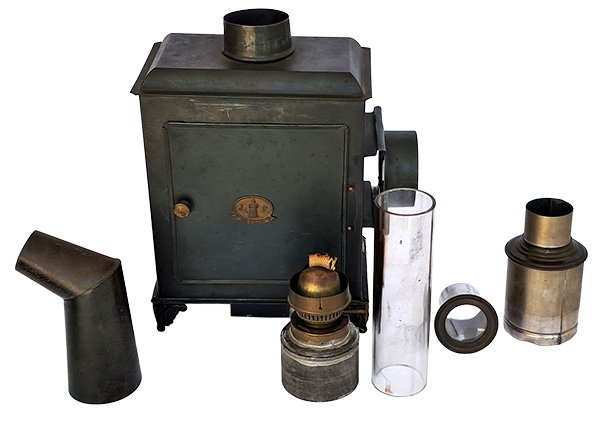
This small lantern in the collection belongs to the massive phase at the turn of the 20th century and was certainly designed for more recreational purposes. Its maker is Johann Falk from Nuremberg. Nuremberg’s tradition of manufacturing all kinds of metal artifacts dates back to the 16th century. It was known as the “City of Toys”. The popularization of the Magic Lantern was made for it, as they had the infrastructure in place to manufacture and distribute them all over the world. Johann Falk was founded in 1895 and operated until 1920.
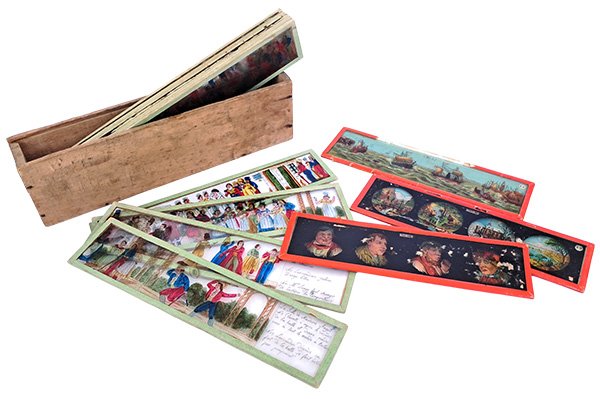
As with photography, an important definition for a Magic Lantern is its format. Usually the images are circular or square and the height ranges from 4 to 10 cm in most cases. This Johann Falk uses 6 cm heigh glass transparencies. The plates can contain individual images, to be viewed one by one, or they can be a continuum and becomes mor dynamic.
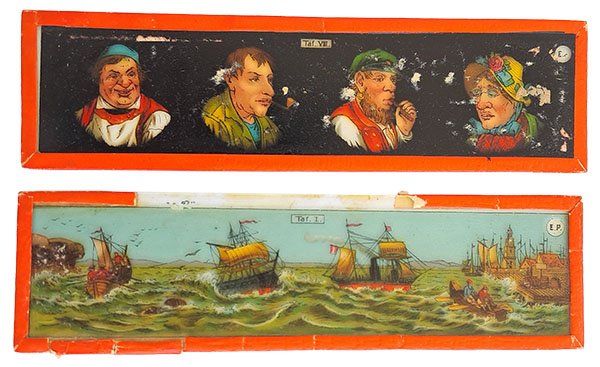
What you find most these days are slides of little children stories or curiosities such as places, animals and characters. This is very much in line with the magic lantern as a toy. Which is still a bit strange in today’s eyes, because it’s a toy that uses fire and combustible oil.