Heliography | Nicephore Niépce
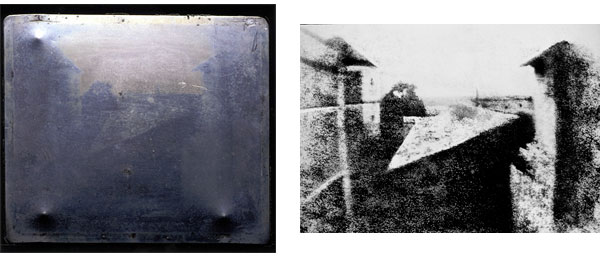
Point de vue du Gras – Nicephore Niépce
–
The image above is considered to be the first photograph in history. It is at least the first to exist to this day, perhaps others have been lost. On the left is the state of the plate that Niépce produced sometime between 1826 and 1827. On the right is a photo of the same plate with adequate light and a good contrast boost to make it easier to read.
The photo was taken from a window in Nicephore Niépce’s house in Saint-Loup-de-Varennes, where the family had an old country estate and where his research was conducted. The name he gave to this process was Heliography. It was not a process that followed on from photography, but its inaugural role is historically important. Also important is the fact that much of what Niépce researched was shared with his future collaborator Louis Daguerre, who effectively invented a viable photographic process, the daguerreotype, which bears some similarities to what Niépce was looking for.
Like almost everyone else who has worked on the subject, Niépce tried to use paper impregnated with some silver salt, but the fact that the image is inverted – what is light becomes dark and vice versa – was a factor that discouraged him from this course of action. What’s more, when he left the camera, the parts that were still light began to darken simply because of the ambient light. He couldn’t stop this process to fix the image and this was another factor that made him give up on the role.
Heliography has many similarities with engraving processes. It consists of:
1- Using a metal plate. Niépce used pewter, which is an alloy of 85 to 99% tin and other metals, including lead.
2- Covering the metal with a thin layer of Jewish bitumen, thinned with some oils and varnishes. This was used by engravers in the etching technique.
3- Expose the plate, thus covered, to the camera, which in this case used a very simple and not very bright lens and therefore required 12 hours.
4- After exposure, the plate was washed with oils (Niépce mentions lavender oil). The solubility of bitumen in oil is altered by exposure to light. The part that has received light becomes more insoluble and the parts that have not received light are washed in oil to remove the bitumen from the plate, revealing the metal. At this point we have a stable image, a photograph.
The bitumen-covered plate process works when exposed to very strong, direct sunlight. This allowed Niépce some success with contact printing. But the image produced by the lens was too dark and the change in solubility was not significant.
If the process had been a success, Niépce would have had two alternatives as a finishing touch:
A- Like an engraver, apply an acid to the plate after having the image made with an accumulation or lack of bitumen on the metal, according to light or dark areas in the image. The acid would “eat away” at the metal, creating grooves that could become ink deposits for later printing, as in an engraving. To do this, you’d just have to use a harder metal than Pewter, as it wouldn’t withstand the pressure of an engraving press.
B- Considering Pewter as the final product, like photography itself. This is the case with what is considered to be the first photograph in history, Point de vue du Gras. What we have there is the very plate that Niépce placed in his camera.
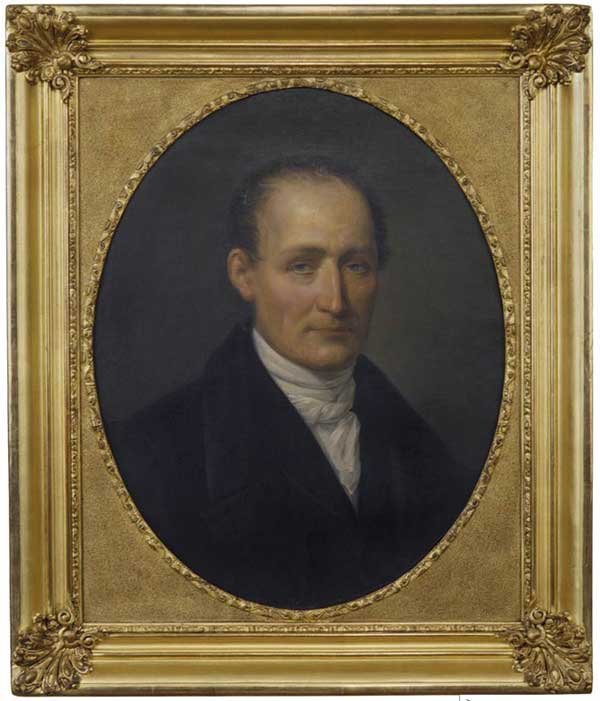
To find out more about the development of photography, from Niépce’s research to the invention of the Daguerreotype, read the article The contributions of Niépce and Daguerre, the story of these two characters is also very interesting from a sociological point of view. While the first is a good representative of a romantic ideal, the second is the bourgeois himself in search of business opportunities.