Lampe Pigeon with Cheminée Junius
Photography, which was made public in 1839, existed long before electricity. It was only in the 1880s that the main cities of Europe and the United States began to be wired, but only in street lighting, then came factories/industries and only in a third phase did homes begin to receive electrical energy. In households it was a luxury item and therefore only used for lighting, and even then not every room in the house. Candles and oil lamps remained essential items.
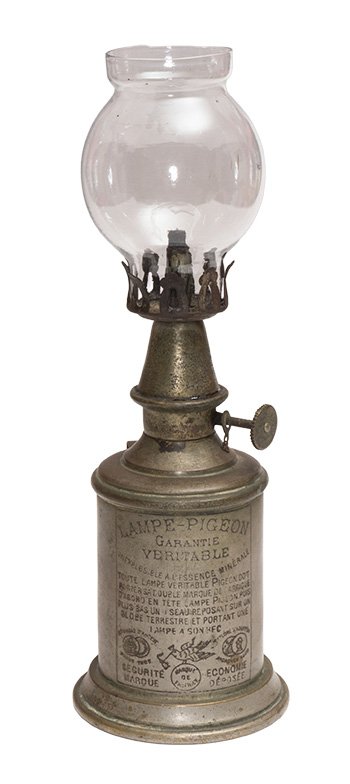
The Lampe Pigeon is a French oil lamp invented and patented by Charles Pigeon in 1884. Main features: It was designed to be relatively safe, portable, robust and inexpensive. The main safety measures included a design to prevent fuel spills in the event of tipping over and features designed to reduce the risk of explosion, which was a concern with the first oil and gasoline lamps. They were usually made of nickel-plated brass, like this one in the collection, and produced a reasonable amount of light for their size.
The Cheminée Junius
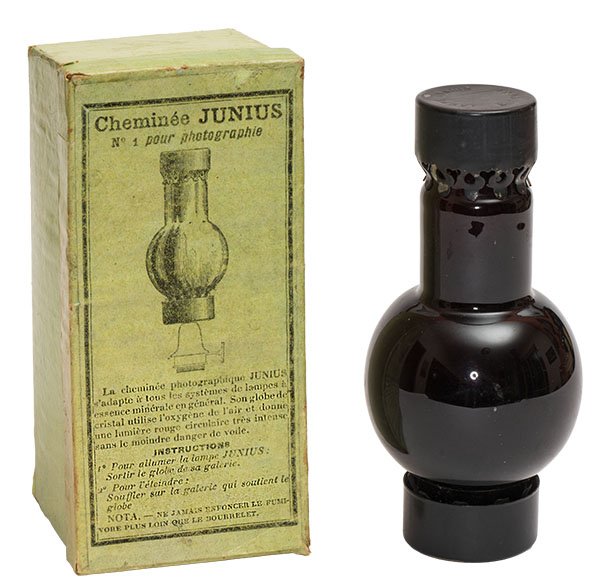
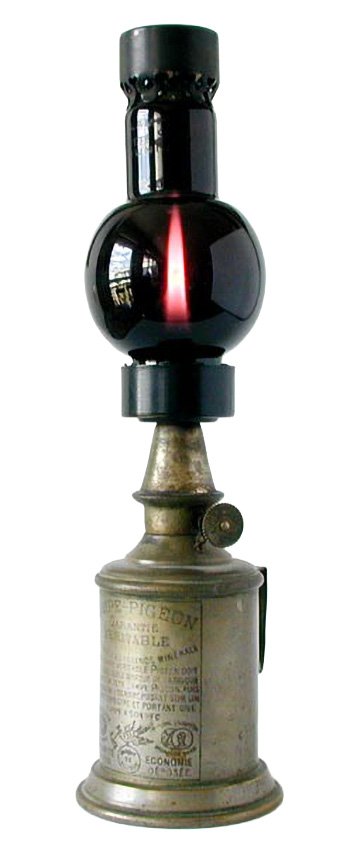
The “Cheminée photographique Junius” is what interests us most. It was a ruby glass chimney that could be installed to replace the original Lampe Pigeon’s. With it, the photographer had a safety light for handling plates, films and photographic papers in his darkroom.
For many decades, this type of accessory was indispensable in the many places not served by electricity. This situation, considering what has been seen above, remained until the middle of the 20th century for anyone who was far from cities of a certain size.
About Ruby glass
There is a mystique about Ruby glass because the key ingredient in producing this color is none other than gold. Medieval alchemists were obsessed with gold (the most “perfect” metal) and its relationship with red (the color of life, blood and the “Philosopher’s Stone”). For centuries, it was believed that this red color was a sign that the gold was “giving its soul” to the material. They didn’t have the physics of colloids; they thought they were witnessing a mystical transmutation.
Golden ruby glass is created by dissolving gold in aqua regia (a mixture of nitric and hydrochloric acid) to create gold chloride. When added to molten glass and reheated, the gold particles do not remain dissolved; they form a colloidal suspension. These nanoparticles are so small (approximately 40 to 100 nanometers) that they scatter light through a phenomenon called the Faraday-Tyndall effect. They absorb blue and green light, letting through only deep red, similar to that of blood.
The red chimney for lamps, such as the Cheminée Junius Lampe, were designed to be safe against actinic radiation. Most were made with golden ruby glass or selenium ruby glass, which was slightly cheaper and more amber in color (developed later, in the 1890s). The gold version was preferred for professional darkrooms, as its “cut” of the blue/UV light was much sharper, protecting the silver halide plates more effectively.
So the red glass or ruby glass found in so much photographic equipment is a direct descendant of the 17th century alchemists’ furnace. When Johann Kunckel perfected “golden ruby glass” in 1679, he was in search of beauty and the “spirit of gold”. Two centuries later, the pioneering photographer used this same alchemical secret to create a safe haven for his silver halide plates. The ‘Junius’ lamp is literally an alchemical tool used for the modern magic of capturing images. The connection with alchemy is direct.
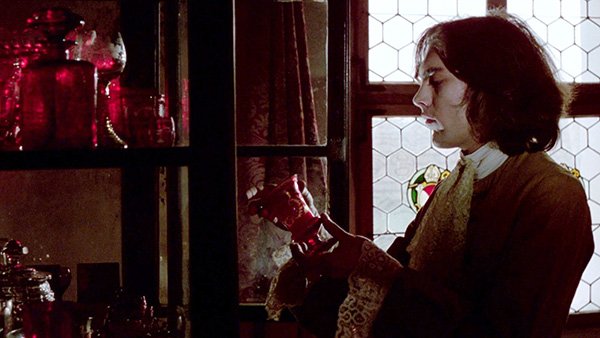
In 1976 Werner Herzog released the movie Heart of Glass. The movie is set in a Bavarian village, where the master glassblower dies, taking with him the secret of “Ruby Glass”. The factory owner goes mad and even kills an employee because he believes that human blood could be the missing ingredient. It’s a fantastic story that Herzog has rendered with a dreamlike, or perhaps nightmarish, atmosphere.