Leica I model A | Ernst Leitz
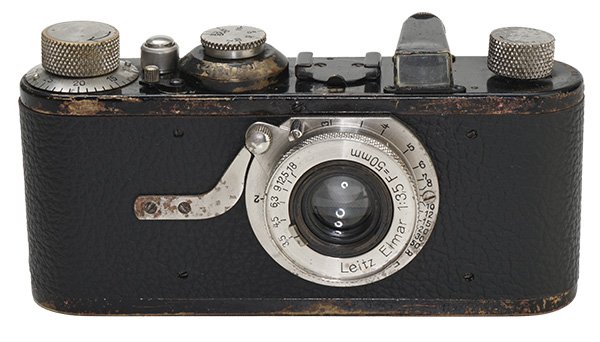
This is the Leica model launched in 1925 at the Leipzig fair. This particular sample was manufactured in 1930. This can be traced back to the serial number as Leitz kept a good record of its production.
It’s very small and the rounded sides make it feel like it disappears between your hands. The index finger of the right hand falls naturally onto the shutter button.
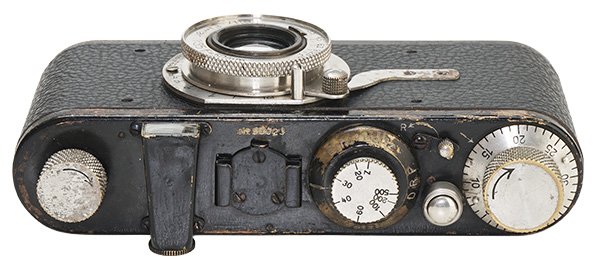
Looking at the top of the camera, from left to right, we have:
- Film rewind button
- Viewfinder
- Shoe for accessories, most commonly a rangefinder
- Speed selector, Z (Zeit, open while pressed, 1/20 to 1/500s)
- Forward or rewind selector lever
- Shutter button
- Button to advance the film and cock the shutter
- Progressive photo counter up to 36
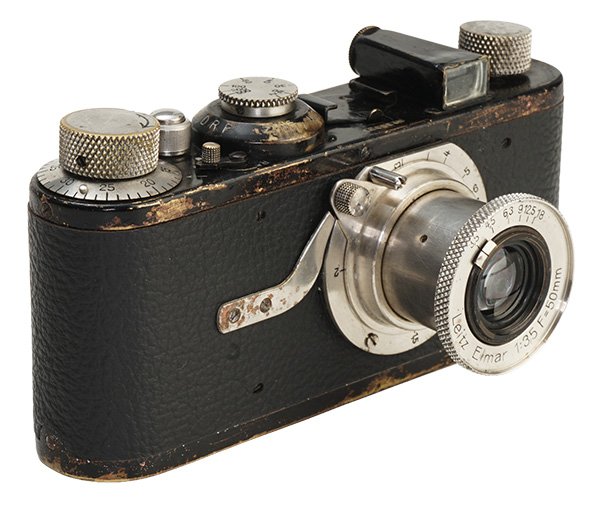
The lens is the Elmar collapsible 50mm f/3.5. There is no focusing aid. Unless you use an external rangefinder, you have to visually estimate or actually measure the distance to the main subject and mark this distance on the lens by turning the lever at the top left. The rod with two screws in position 9h keeps the lens in the infinity position and you have to release it for any other distance.
This particular Leica has a relatively rare feature. Its Elmar focuses down to 1.5 feet or approximately 45 cm. The overwhelming majority of Elmar lenses focus down to 1 meter. Unfortunately, Leitz didn’t give a special code for these lenses and it’s difficult to trace. What is known is that they were usually marked in feet and that they equipped some Leicas I because from Leica II onwards, due to the addition of a rangefinder on the camera itself, the minimum distance had to be 1m.
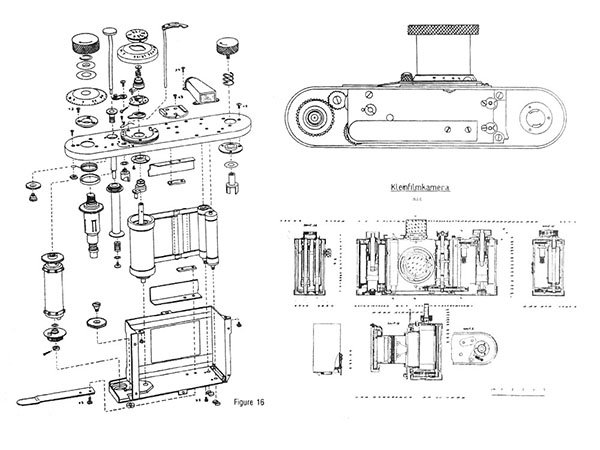
The camera as a whole is very robust. It has around 200 parts but none of them are very delicate and everything fits together perfectly without any gaps.
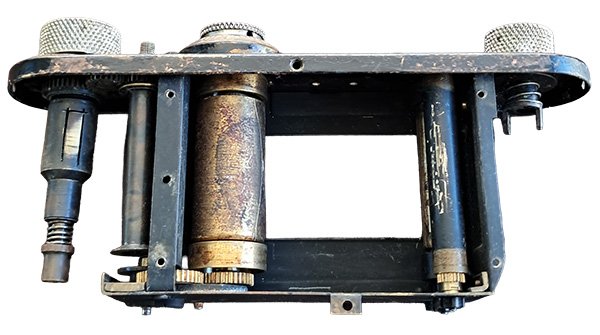
The thing to watch out for with these cameras is the two curtains. One opens the frame and the other closes it. The material is rubberized fabric and over time they dry out and need to be replaced. I had to replace this Leica I A because when it arrived it looked like it had been abandoned for decades. That’s how I got to know and admire this engineering gem better.
In use
For those who were born with automatic cameras or smartphones, the idea that you have to manually adjust the shutter speed, aperture and focus for each shot can cause a certain panic. But that’s not the Leica spirit.
The strategy is to think that every photo takes place in an environment that the photographer is already in. He doesn’t wait to see something interesting before he starts measuring or estimating the light. If he’s on the street (Leica’s natural habitat), he already has the camera set to something reasonable according to the daylight. It could be something like 1/100s, f/8 for an ISO 100 film. If he enters an environment, a well-lit room, he already opens the lens to f/5.6 and drops the speed to 1/60.
The key is to be prepared. Depending on the subject, leave the focus locked at infinity, maybe 12 feet, 6 feet? That way, if there are any last-minute adjustments, it’s easy to make them or, if it’s an elusive subject, just frame, shoot and adjust later in the lab. With a little practice, anticipation becomes automatic and is a photographer’s best friend.
To top it all off, the time needed between one shot and the next with the Leica became a matter of one second, just long enough to turn the shutter release. Compared to everything that existed at the time, this was a very radical change and brought a new dynamism to photography.
It’s true that falling plate cameras also allowed very fast sequences to be taken, but the ergonomics of these cameras, the brilliant finder, the enormous size and the noise made by falling plates, made it clear how clumsy and obsolete they were.
The first camera in which everything was in place for silent, sneaky photography, free as the eye itself and with image quality, was the Leica.
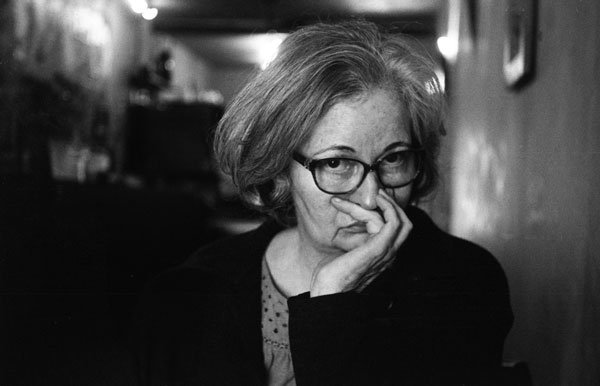
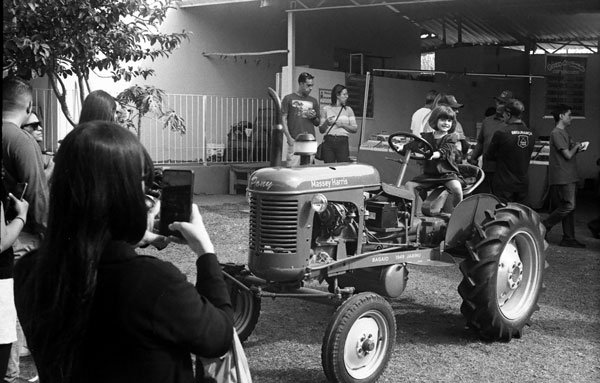
Above, a portrait taken with this Leica I A in a restaurant. Below, a snapshot at an agricultural fair. Both photos were taken without a light meter or rangefinder.

If you are in the themed circuit The Leica Revolution, use the buttons below to navigate through the rooms.