Spherical aberration
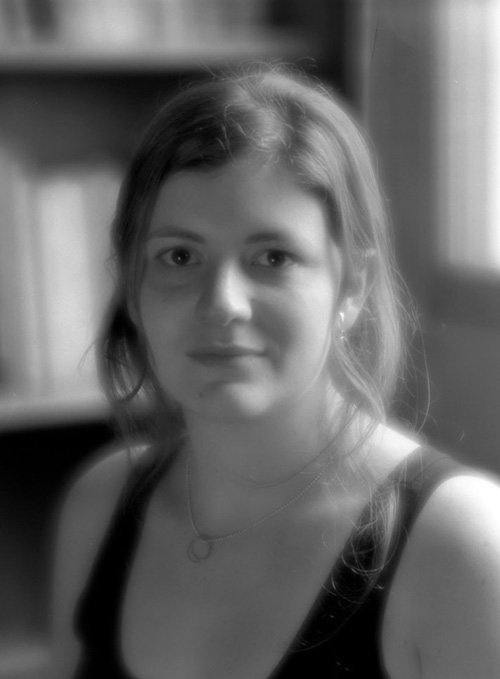
Spherical aberration is mainly the responsible for the soft focus in the photo above. When Wollensak Optical Co, Rochester N.Y. USA, launched the Verito lens at the beginning of the 20th century, the pictorialism movement was in vogue and diaphanous images like this were highly prized. That’s why the optical design of the lens purposely left a good deal of spherical aberration uncorrected specifically to produce this effect.
Note that although we use the expression soft focus, this is not an out of focus image. It wouldn’t be possible to produce the same effect with an ordinary camera lens, with the spherical aberration well corrected, just by not focusing the subject. This is clear if you look at the strand of hair on the right-hand side of the photo. It would be completely blurred and wouldn’t show up if it was only by focusing closer or further away.
What happens is that we have two superimposed images. A clear one, with relatively small circles of confusion, and a fuzzy one, with large circles of confusion, which create a halo hovering over the clear image.
The origin of spherical aberration
Anyone who has played with a converging lens on a sunny day must have formulated a mental model for the path of light that looks something like this:
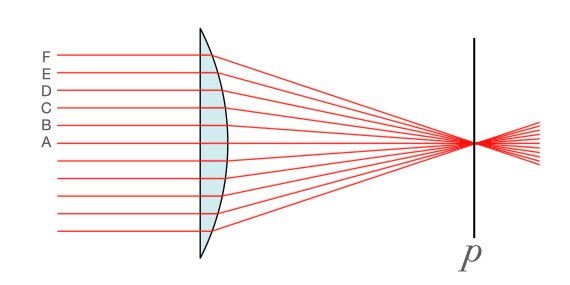
The red lines represent the sun’s rays arriving parallel to each other and to the axis of the lens and converging on a well-defined point in a p-plane.
Anyone who actually looked at what was going on saw that the point in the p-plane isn’t really a point at all. One of the reasons is spherical aberration, because what actually happens is something like this:

The rays that pass closer to the center of the lens, say A, B and C, converge at a greater distance than those that pass more towards the periphery of the lens, such as D, E and F. This is a consequence of the sphericity of the lens and that’s why the aberration is called “spherical”. But there’s nothing wrong with that. By applying the laws governing the behavior of light, the practical result fully coincides with the theoretical one. It’s not a question of errors in precision or the quality of the lenses.
Due to the greater concentration of rays cutting through the image plane very close to the lens axis and the fact that they disperse at more distant points, you can imagine that this point will be very bright in the center and will gradually lose intensity.

It would be something like the illustration above. In practice there would be fringes because another phenomenon called interference would occur. But we won’t go into that here.
Remedies to reduce spherical aberration
First, it’s important to say that it can never be fully corrected. But it is possible to reduce it considerably, or rather sufficiently, in most cases. Enough in the sense that every sensor/film has a maximum resolution, beyond which details in the image are no longer perceived. Our eyes also have a maximum resolution and can’t see details beyond a certain point. If this sounds strange to you, read the article Resolution in photography.
Thus, if the growth of the minimum circle of confusion, due to spherical aberration, is kept within certain parameters determined by the resolution of the image on the sensor/film, then by the resolution in the print on paper or screen and also by the conditions of observation with our eyes, the image will be satisfactory and will appear sharp as if it were a real scene.
Use of the diaphragm
A very obvious measure, from what has already been shown, is to use only the central part of the lens as much as possible.
If it’s the rays that pass through the periphery that focus at shorter distances than those that pass through the center, using an iris or any other diaphragm will take advantage of a part of the lens that is more coherent.

The portrait above was taken with the same Wollensak Verito 9″ that took the portrait that opened this article. The only difference is that in the first one, the soft focus was produced thanks to the iris being wide open at f/4 and in the second one, a tighter aperture was used, at f/8, which practically eliminated it.
It’s important to note that although this effect of spherical aberration is also influenced by aperture, it has nothing to do with depth of field. Depth of field affects objects at closer or farther distances from the focal plane and the loss of sharpness is exacerbated by large apertures. With spherical aberration, the effect is felt across the entire field, including objects above the focal plane.
But the problem with controlling spherical aberration through the aperture is that the more you close the lens, the darker the image becomes, but often you want both: a clear, sharp image with no spherical aberration. In this case, the lens needs to be specifically designed to correct this aberration.
Correction of spherical aberration
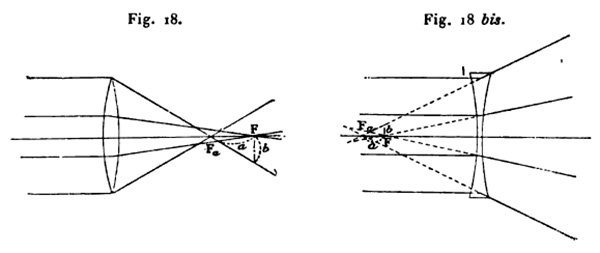
The drawing above is from Étienne Wallon’s 1891 Traité élémentaire de l’objectif photographique. It shows a converging lens on the left and a diverging lens on the right. In it we can see that the rays closest to the edge of the lens focus closer to the lens, while in the diverging lens the opposite is true, as we can see from the dotted lines. The first case is called positive spherical aberration and the second negative.
Well, this inversion is used to mitigate the effect by adding, to the converging lens, a second diverging lens that alleviates the spherical aberration but still keeps the whole system convergent so that there is an image.
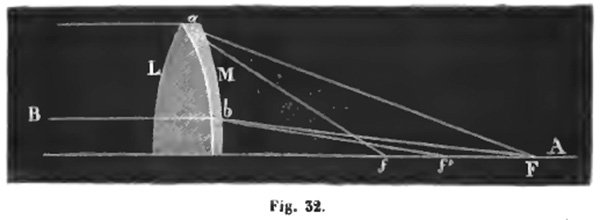
Now the drawing is from Désiré Monckhoven’s Traité d’optique photographique from 1866. It shows two lenses cemented together. The one on the left is converging, indicated by L, and the second is diverging, marked by M. This is the classic arrangement for attenuating spherical aberration.
To understand what is happening qualitatively, we can imagine that a ray that is parallel and close to the axis, represented by B, will suffer a relatively small divergent deviation. If without the corrector lens M it would arrive at f ‘, with a small deviation it will go to F. The ray at the top of the lens, on the other hand, which would be diverted to f, with the corrector lens suffers a greater divergent deviation because the angles of incidence are more acute and it will also go to F, greatly reducing the effect of spherical aberration because both rays converge on the same point.
An additional convenience for this arrangement of cemented lenses is that it is, at the same time, the most widely used for correcting another aberration, chromatic aberration, due to the fact that, strictly speaking, each color focuses at a different distance. But there are also optics generally called dialyt that use separate, unglued doublets. What lens designers do is adjust the curves and glasses used in order to correct each of the two aberrations in a balanced way.
The scope of these considerations
It may not seem like it, but the cases we’ve examined are extremely simple. We are only considering rays parallel to each other and parallel to the axis of the lens, which simulate objects very far away and on the axis of the lens. In a real situation, of course, many objects send light to the lens, hitting it obliquely and producing images off the axis of the lens. In wide-angle lenses, these distances can mean very dramatic deviations, which is why they are the most difficult to design and manufacture.
Another important point: we are only considering monochromatic light to avoid introducing the effect of chromatic aberration mentioned just above.
When these more generic situations are considered, the principles still apply, but the results vary for the worse in terms of image quality. The center of the image is always the best condition and its periphery, like the periphery of the lens, is when all the problems become more complex and difficult to get around.