Chromatic aberration
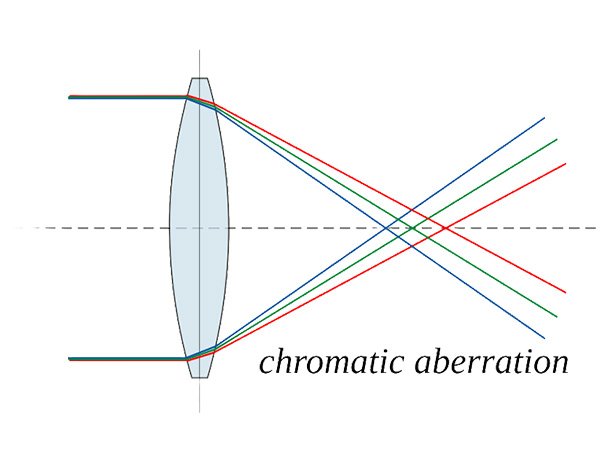
The basic reason for chromatic aberration is very simple: different colors deviate differently when light rays pass from one medium to another. This can be between air and glass, glass and air, or even two different glasses. If this is strange to you, read the article on refraction, dispersion and optical glass.
The consequence of this is that the image for the red portion of a scene is formed at a greater distance than the blue portion for the same scene, as can be seen by looking at the diagram above.
The effect in black and white photography is more of a loss of definition. In color, depending on the contours of the elements in the image, some colored fringes may appear. As is the case in the photo below with the violet tones that appear at the edges of the branches.
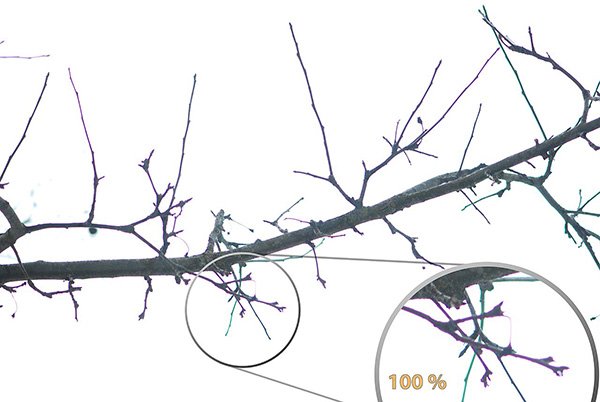
Depending on the subject, chromatic aberration can merge between figure and background and go unnoticed.
History
Long before photography, chromatic aberration was already a problem for astronomers because in telescopes, with the black background of the night sky, the uncorrected effect is truly disastrous.
The story of the invention of a solution to this problem is a curious one. An English lawyer, Chester Moore Hall, who was passionate about optics and astronomy, was probably the first to propose a second lens to at least partially correct chromatic aberration.
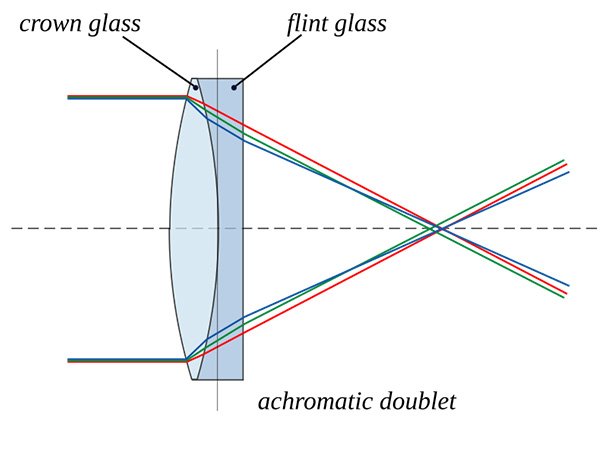
This is what the diagram above shows. The lens that uses crown glass is cemented to another lens with flint glass, two types of glass with different indices of refraction and dispersion. What happens is that the first glass is convergent, but the second glass is divergent, reversing the order in which the rays deviate and thus bringing their focal planes very close together, but not completely.
The anecdotal fact of the story is that Hall didn’t want to share his discovery with anyone. It seems that he liked the idea that he would be the only human being to appreciate images of the skies with a fidelity never seen by his contemporaries. To keep his secret, he contracted the manufacture of the lenses to two different opticians, Edward Scarlett and James Mann. Each of them, however, subcontracted the work to the same person, George Bass, who soon realized that the two components were for the same client because the two pieces had the same diameter and a common curvature (so that they could be glued together). He assembled the two lenses and was able to observe, even before Hall, that the effect, the improvement in the image, was truly fantastic. But this only served to show that Hall was the pioneer. As was his initial idea, he didn’t publicize his discovery and the solution didn’t spread.
What happened was that at the end of the 1750s another Englishman, John Dollond, heard about Hall’s experiments from Bass himself and it was he, Dollond, an optician and instruments maker, who developed and patented the achromatic doublet in 1758.
The apo-chromatic
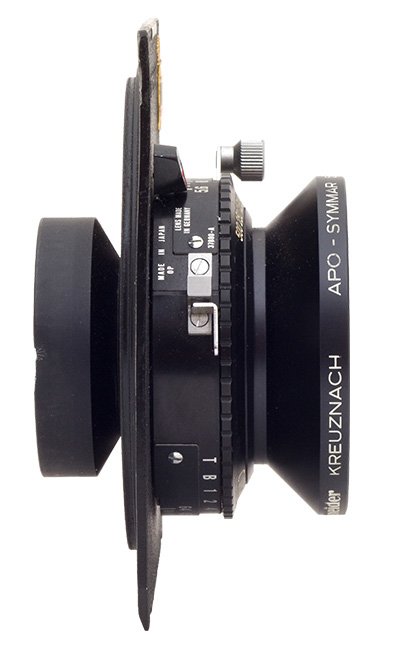
Many lenses have an “apo” prefix. For example, Rodenstock’s Apo-Ronnar or Schneider’s Apo-Symmar. This refers to an apo-chromatic lens and means that it has more correction than simply achromatic lenses. The addition of diverging lenses is the way to improve chromaticity and also spherical aberration. An apo lens has a superior performance in both aberrations and produces images with really superior sharpness.
The right measure
But as everything in optics is a question of trade-offs, we shouldn’t strive for perfection when it comes to achromatism, as this would mean sacrificing something else that is probably more important. At a certain point, the support that will receive that image will no longer have the resolution to distinguish the skinny fringes that may form around some objects. The correction of any aberration should be designed to only reach the limit of the support’s resolution, anything beyond that is a waste.
This is important to consider in relation to this fashion for using vintage lenses on digital cameras. Wonderful lenses like a Biogon or Sonnar were made for film resolution and this has already been surpassed by the latest digital sensors. The consequence is that when we view images in 1:1, pixel by pixel, the bangs of chromatic aberration can appear. This doesn’t mean that they are bad lenses. They simply weren’t designed for the resolutions beyond what was available at their time.
Do not correct
It may seem strange, but the option of simply not correcting chromatic aberration wasn’t just for cheap box camera lenses that only had a meniscus as a lens. At the turn of the 19th to the 20th century, right at the height of the pictorialist movement, some expensive lenses were proposed that allowed spherical and chromatic aberration to pass through, to varying degrees.
Although both aberrations are corrected with the addition of a diverging lens, the optician can prioritize one or the other correction depending on the choice of glass and its geometry. Lenses such as the Darlot, Objectif d’Artiste, designed by Puyo et Pulligny, basically used the absence of chromatic correction to achieve the soft effect.
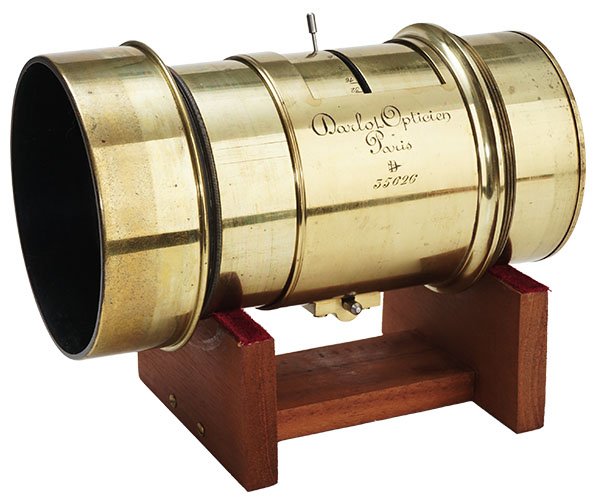
That’s why they called it anachromatic, the double negative “ana” meant that it wasn’t corrected.
The other strategy for achieving soft focus is the one explained in the article on spherical aberration. This is the case, for example, with Wollensak’s Verito and also the Universal Heliar, that has an adjustable amount of spherical aberration that the photographer can play with.
Chemical focus
Before it was an artist’s thing, chromatism was a problem in the early years of photography. The daguerreotype, calotype and all the processes of photography’s infancy were sensitive only to blue and violet (the most energetic part of the spectrum). But our eyes are much more sensitive to green, yellow and red than to blue. What happened then was that when the photographer saw a sharp image on the ground glass, he was basing his judgment mainly on the green/yellow/red part of the scene to be photographed. But when he put his plate in, it only saw the blue and as the lens had no chromatic correction, the focus of the blue was closer to the lens. The image was blurred.
To get around this problem, photographers used to focus visually but then, before exposing the plate, they would shorten the lens/plate distance by 1/30 or 1/40th of the focal length and call this chemical focus adjustment.
But if John Dollond had already published his patent for achromatic lenses in 1758, why did photographers still have to struggle with this “chemical focus” almost 100 years later? The point is that while Dolland had to unite the focus of the green and yellow neighbors only, which is the privileged region for the human eye that in his case looked through a telescope, for photography it was necessary to bring the distant blue/violet into the same focus. This required much more refined glass and calculations, which only came about during the 1840s among the major manufacturers.
Objectif d’Artiste with panchromatic emulsion
One last observation is that the fact that all the old soft focus lenses using chromatic aberration, as it chief resource for a soft focus image effect, like the Darlot Puyo and Pulligny, were designed for emulsions sensitive only to blue/violet. That means that the result is very different if they are used today with pan-chromatic emulsions. When a photographer at the beginning of the century focused on yellow/green and then adjusted it to blue, as the yellow/green was not registered by the emulsion the image came out much “cleaner” than it would today with a pan-chromatic emulsion that would also register the yellow/green more severely out of focus and the blue in focus at the same time. So, with pan-chromatic emulsion a far more pronounced effect can be expected with contemporary pan films.
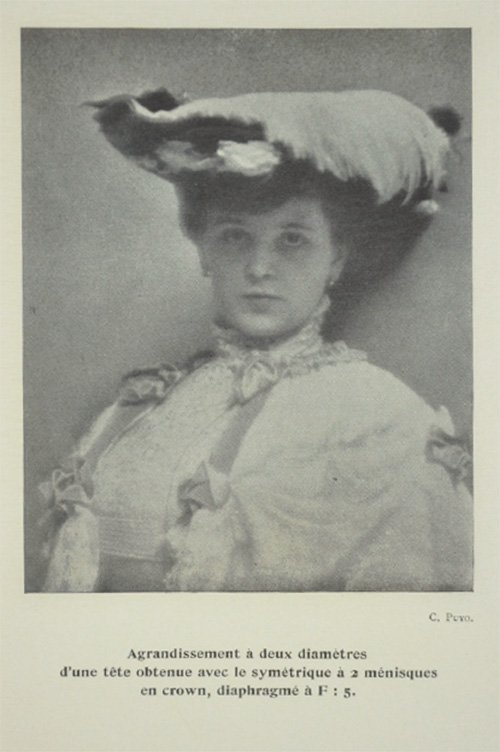
Above, a photo reproduced from the book Les objectifs d’artiste : pratique et théorie des objectifs et téléobjectifs anachromatiques / L. de Pulligny, C. Puyo