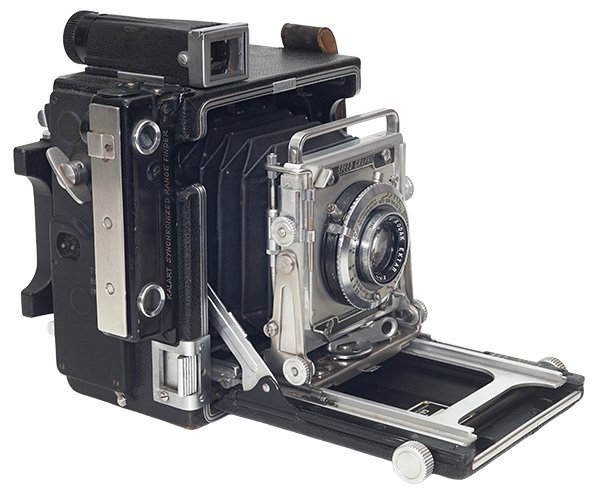
Graflex Speed Graphic 23, the Baby | Graflex
It was with the Graflex brand that the Folmer & Schwing Manufacturing Company became the largest manufacturer of professional cameras in the United States. Between 1905 and 1926 it was a division of Eastman Kodak dedicated to the premium market and took advantage of the massive distribution power of the parent company to consolidate itself in the United States and also have a significant presence in Europe.
Between 1900 and 1920 was the era of its large-format monoreflex, the Graflex Auto. It offered the advantage, over traditional view cameras, that the photographer had a real-time, straight image, inverted only laterally, and could frame, focus and shoot at any moment because only a fraction of a second, enough for the mirror to rotate and get out of the way, separated him from his great shot.
This concept made the brand successful and famous. But the growth of press photography put pressure on the industry for faster and lighter cameras. Then came the idea of adapting the curtain shutter of the original Graflex into a mirrorless camera, in which the framing could be done on ground glass, when the shot allowed it, but could also be done by a sports finder, wire frame, and the focus by a rangefinder. This is how the Speed Graphic series was born in 1912. Initially for 4×5″. There was also a 5×7″ format, but this was later discontinued due to the trend towards miniaturization that was driving the entire industry.
It was also the trend towards miniaturization that led to the launch of a new Speed Graphic series in 1938, this time giving the lead to the 2¼ x 3¼” format (57.15 x 82.55 in mm), as the 4×5″ equivalent came just two years later in 1940.
This series was called the Speed Graphic Anniversary and brought several improvements such as a Kalart side rangefinder, a two-stage drop bed for more angular lenses and flash synchronization. The Graflex in 2¼ x 3¼” format became known as Baby.
Baby Speed Graphic photographers
Handling a Baby today, it doesn’t really give the impression of being a “light and practical” camera. But you have to consider the context of the time to understand that it came as a reaction to the launch of the Leica, which is still a very light and practical camera.
The point is that it’s true that the Leica was a huge success in the 1930s, when it established itself as an excellent camera. But it’s also true that it met with resistance among professional photographers and some magazine editors even refused to use such a small negative in their publications because of the film’s very apparent grain.
In this context, the Speed Graphic Baby was the professional’s Leica. For those who still resisted taking 35mm film seriously, and the emulsions of the time didn’t help much, the Baby had several features that still spoke to both worlds: a more generous format, the possibility of using 120 sheets or rolls with adapters, ground glass but also a direct viewfinder, a rangefinder for precise focus, a speed of up to 1/1000s, in short, it had the attractions brought by Leica photography, but it could also be used in the traditional way with a tripod and black cloth.
Because of these, shall we say, transitional characteristics, it was adopted by professionals, especially journalists, but also by a considerable number of advanced amateurs for whom this hybridity of being able to take snapshots and also carefully studied photos with the same camera was, and still is, a very interesting attraction.
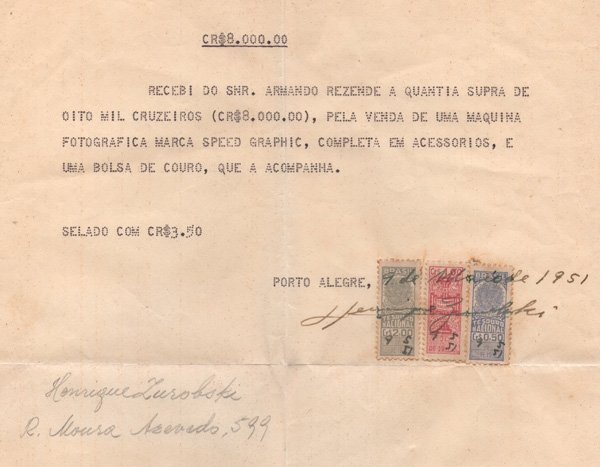
Above is the sales receipt, which also gives an idea of the positioning. This camera was sold in May 1951 for Cr$8,000.00. At the time, this was equivalent to the salary of a manager or specialized mid-level professional. Perhaps something like R$ 10,000.00 to R$ 15,000.00 reais or 1,800 – $2,700 USD. Clearly it was a premium camera for a very select audience. This receipt still looks like something between private individuals and the store price for a new camera would probably be even higher.
A Baby Speed Graphic

This model in the collection is a camera manufactured between 1947/48 according to its serial number. It has a wooden body and the moving parts are made of very well treated metal, both in terms of machining and finishing.

It is equipped with a Kodak Ektar with a T, B, 1s to 1/400 shutter, offering in this way the option of leaving the focal plane open and just using the one already built into the lens. This is very convenient when using electronic flash, as the timing is more flexible and can be done at any speed.

On the right-hand side of the camera body is the focal plane shutter control. It’s a single-curtain shutter with slits of varying sizes in sequence. Depending on the slit and the tension of the spring, the shutter speed is set, which can be read in a small window. 1/30 s in the photo above. This may confuse those who are used to two-curtain shutters, as all 35mm shutters are. As in this case the slit is always open, if the shutter is reset it will pass over the film and burn the last shot. The correct sequence of operation is:
With sheet film holder
1- Insert the holder but do not remove the dark slide.
2- Cock the shutter: Turn the advance knob to the desired speed.
3- Remove the dark slide
4- Take the picture
5- Go back to step 1 for the next shot.
With 120 film adapter
1- Insert the adapter positioned on the first shot or advance to the next shot but keep the dark slide in place.
2- Cock the shutter: Turn the advance knob to the desired speed
3- Remove the dark slide
4- Take the picture and insert the dark slide again
5- Go back to step 1 for the next shot.
We can see that it’s not as practical as an ordinary focal plane shutter camera. This considerably increases the time between shots.
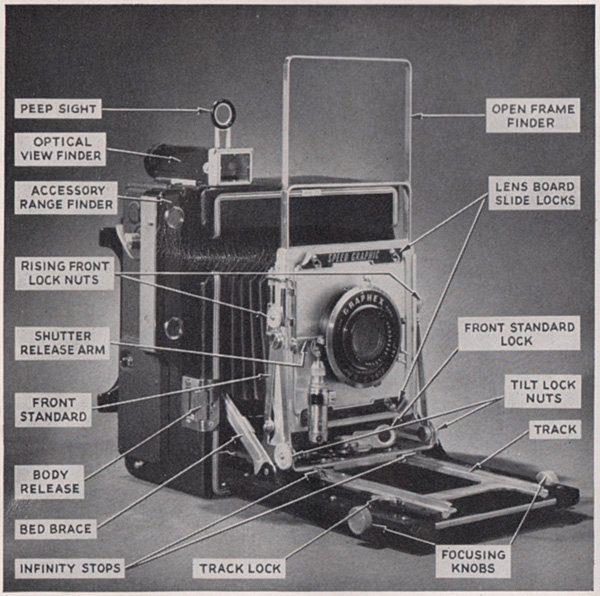
Some large format camera features are possible with the Baby. On the manual page above, we see that you can tilt the lens plate (tilt lock nuts), you can also raise the lens plate (rising front lock nuts) and you can also move it sideways (front standard lock). The movements are not extensive, but they solve the most common cases.
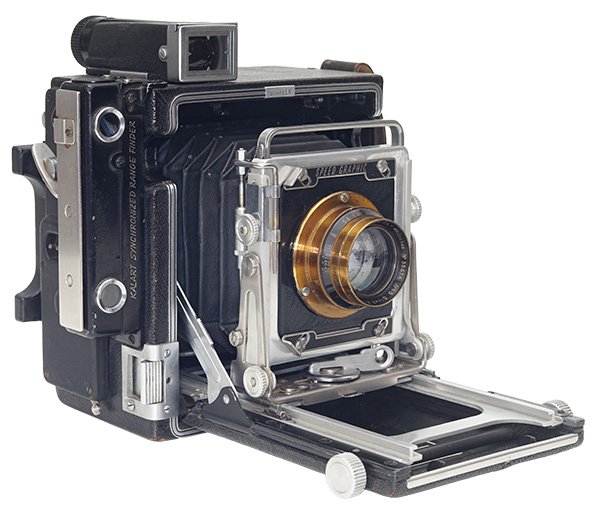
One possibility that is very interesting today with Speed Graphic is the possibility of using lenses in barrel, as is the case with many of the old ones. In the photo above, it is using a Taylor, Taylor & Hobson – Cooke Anastigmat Series II, which would be difficult to use otherwise. It has a focal length of 127 mm and a maximum aperture of f/4.5. It was even possible to adjust the rangefinder to work with this focal length instead of the 101 mm of the original Kodak Ektar that came with the camera.
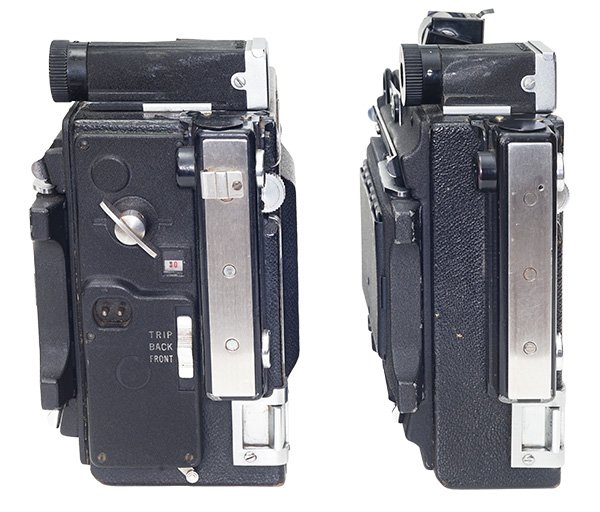
Without discontinuing the Speed Graphic, Graflex launched the Crown Graphic in 1947. Basically, the new model did away with the focal plane shutter and left only the leaf shutter that was already incorporated into the lens. The Crown is lighter and smaller than the Speed, as can be seen in the photo above. A good reason for this was that without the distance imposed between film and lens by the curtain shutter mechanism, the Crowns allow the use of wider-angle lenses up to 65m.
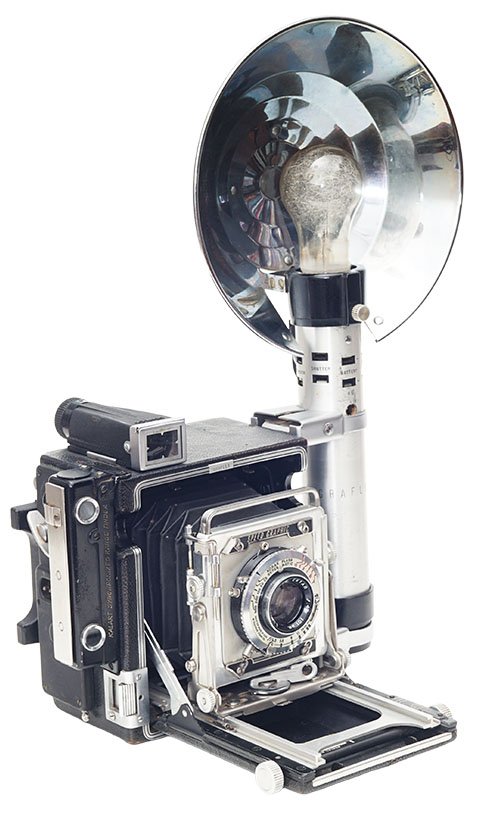
Very typical of all Speed and later Crown Graphic is the use of flash bulbs. As they are very powerful and allow very small apertures to be used at moderate distances, photographers opted to set a distance on the rail scale and not worry about focusing through the rangefinder, relying solely on depth of field. This solved the problem at many social events when one needs to act quickly.
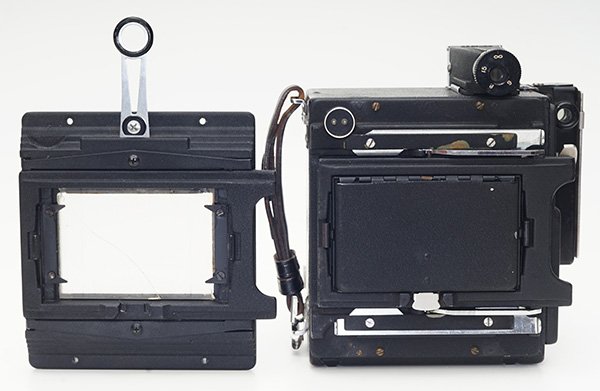
One thing to note about the Crown or Speed Graphic is that it has two types of back, shown in the photo above. The one on the left only allows the traditional holder to be inserted between the ground glass and the camera body. The one on the right, called the Graflok back, allows the entire back, with the ground glass, to be removed and a 120 film adapter installed instead.
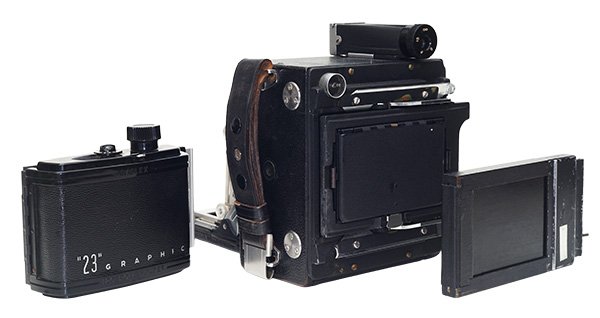
Above is the film holder, to the right of the camera, and the 23 Graphic adapter which allows 8 photos in an approximate 6×9 cm format. There are also adapters for 6×6 cm, in which case they make 12 photos and must be accompanied by a viewfinder mask that corrects the framing for the square format. These are original Graflex accessories of excellent quality.
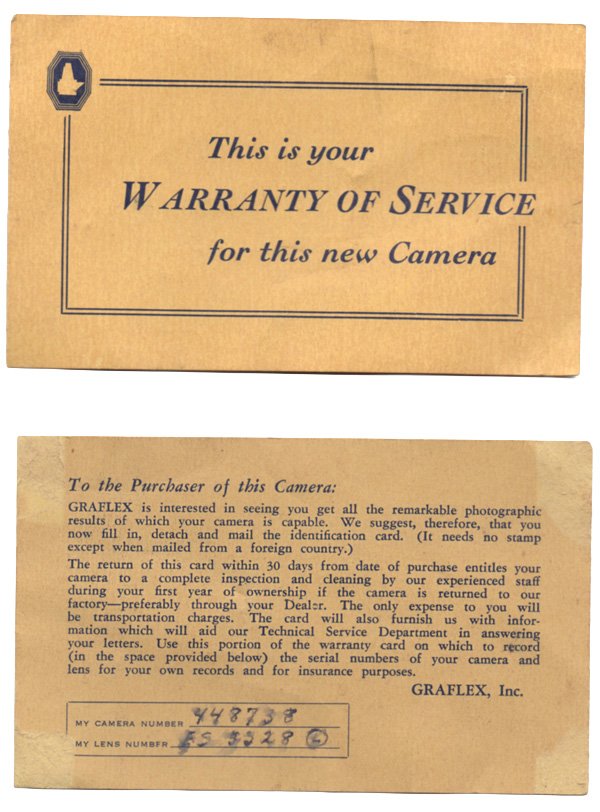
Above is a card that came with the camera. It opens by saying: “Graflex is interested seeing you get all the remarkable photographic results of which your camera is capable”. It’s interesting to note that there is implicit doubt that the photographer is up to all the wonders that the camera offers. But … That’s fine. In any case, the card still offers a free check-up in the first year to clean and adjust the equipment. That’s very nice of the manufacturer.
An experience
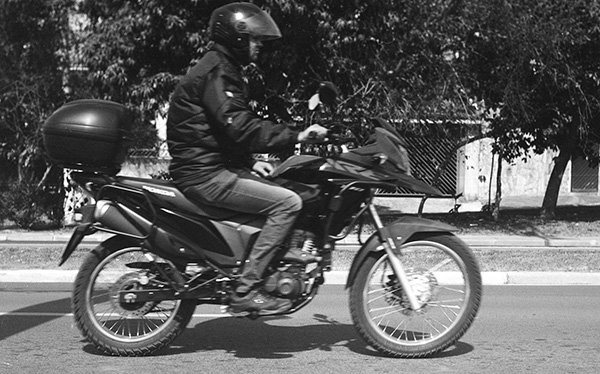
One of the most famous of the many photos taken with a large-format focal-plane shutter is that of a car race in which the wheel became oval because a small gap ran vertically in front of the film while the car ran horizontally.
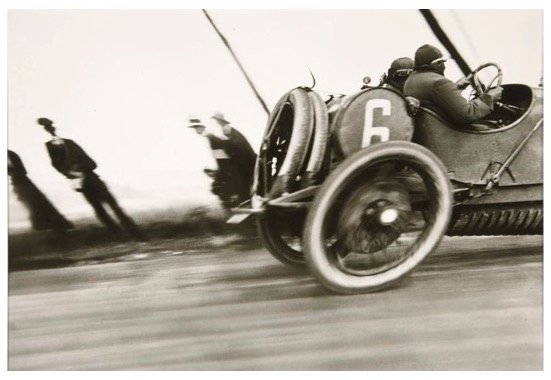
I decided to experiment with the Baby Speed. I set it so that the smallest gap in the shutter was used and stood in the street photographing passing motorcycles.
It’s not easy. The best I could achieve was the result below, where the oval is noticeable but not very expressive. Still something to perfect. But you can see that it works. Maybe in a highway.