year
Chronological circuit, 1956 to 1965
1956
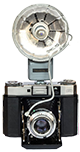
Zeiss Ikon, Super Ikonta IV
A beautiful way to round off the historic Super Ikonta series. The IV has a rangefinder in the viewfinder and attached to the focus. It also has a selenium light meter. It’s robust and very compact for a 6×6 cm. An excellent travel companion.
–

Zeiss Ikon, Contina
A 35mm that is very much the miniature of one of the old Ikontas for 120 film. Fully manual and with good flexibility of speeds, apertures and focus distances.
1957

Hasselblad 500 series
Medium format 6×6 cm on 120 film. It was extremely innovative, precise and long-lived. The example in the collection is a 501CM, still fully mechanical, manufactured in 2000.
–

Kodak AG, Retina Reflex
A German monoreflex with the leaf-shutter concept, it was launched to compete with Zeiss Ikon’s Contaflex, as it seemed to German companies that this was the future of 35 mm photography.
–
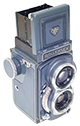
Franke & Heidecke, Rolleiflex 4×4 (baby)
This camera was launched for the amateur market with a focus on the “super slide” made with 127 film in 4×4 format. They were 85% larger than 35mm and slide projections were very fashionable.
1958
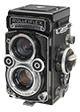
Franke & Heidecke, Rolleiflex 3.5 F
The heyday and the beginning of the end for the Rolleiflex TLR. By the early 1960s, there was no longer any room for such a camera, even though it was still an exquisite example of quality and reliability. More affordable brands such as Yashica and Mamiya gave the TLR a chance to survive, but the system really became obsolete.
–
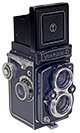
Yashica, Yashica D
Yashica had been producing TLRs since the early 50s. At the beginning of the 1960s, it launched the Mat 124, which was a huge success and remained on the market until the 1980s. Much more affordable than the Rolleiflex, it gave life to the concept of twin lenses.
1959

Nippon Kogaku, Nikon F
A revolution in photography comparable only to that of Leica in 1925. The difference being that while Leica aroused a certain amount of skepticism among the other manufacturers, with Nikon the competition was already wide awake and responded quickly by sharing the new cake.
–
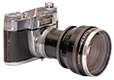
Voigtlander, Bessamatic
The third traditional German brand to enter the 35mm monoreflex camera market. A big step in the wrong direction. The camera is yet another feat of engineering, but with a concept that was already doomed to fail.
–

Welta Kamera-Werke Penti
This 35mm half-frame has a unique design and was undoubtedly for the amateur market. However, with speed, aperture and focus-by-distance settings, you had to know how to shoot to be able to use it.
–

Eastman Kodak, Kodak Brownie Starmite
A camera in the long line of Brownies, which began way back in 1901. Firmly established in the amateur market, it puts ease of use – just press the button – above the quality of the final image. It’s fun to use, and with a flash, it’s ideal for snapshots at birthday parties.
1961
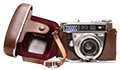
Kodak AG, Retina Automatic
Using a selenium light meter, which doesn’t need a battery, Kodak and many other brands launched amateur cameras that automatically adjusted the aperture according to the light conditions.
1961
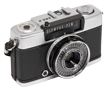
Olympus, Olympus Pen
A new concept within the amateur camera market: an easy-to-use camera like a Kodak, with image quality comparable to a Zeiss, at a very affordable price, impeccable quality and taking twice as many photos as using half a frame, it was a huge success.
–

Monoculars for half-frame slides
Very fashionable in the 60s and 70s, these small monoculars offered a huge view of the small slides produced, mainly by the Olympus Pen.
1963
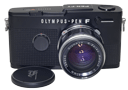
Olympus, Olympus Pen F
A bit like Leitz showed with its Leica in 1925, Olympus argued with its Pen F that a good camera could generate quality images even with a small format. The Pen F makes half a picture, but it’s a very sophisticated camera in terms of features and engineering.
–
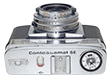
Zeiss Ikon, Contessamat
Automatic or manual exposure with a good range of shutter speeds and apertures. Viewfinder rangefinder that still shows the aperture. Camera for the amateur market already in its final years from Zeiss Ikon.
1964
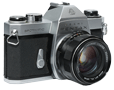
Pentax, Pentax Spotmatic series
Extremely popular among SLRs, the Spotmatic is a camera famous for its simplicity, robustness and ergonomics. With the M42 thread standard, it also allowed the use of optics from many manufacturers other than the brand itself.
1965
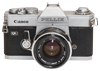
Canon, Pellix
Introduced an SLR system with a fixed mirror that “steals” around 30% of the light for the viewfinder and does away with the noise, vibration and blind moment of the moving mirror.
–
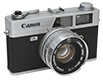
Canon, Canonet QL17
Very popular rangefinder with built-in rangefinder and parallax correction directly in the viewfinder. The lens is not interchangeable but is an excellent 50mm f/1.7.