In his catalog of 1846, therefore soon after the entrance of Secrétan in the business, two types of photographic lenses are mentioned: Objectif Achromatique and Objectif à Verres Combinés (verre is glass in French). They appear organized by the size of the plate to which they are intended. It was still not common to speak of focal length and nor diaphragm or aperture to specify a lens. Whole plate was 16 x 22 cm, and then came its fractions 1/2 plate, 1/4 and 1/6. Later the somewhat larger size 18 x 24 cm was adopted as the European whole plate size and this is a format that is sold to this day.
Objectif à Verres Combinés was another name for Petzval’s portrait lens and had two achromatic doublets, one cemented on the front and one air spaced on the rear, leaving the diaphragm positioned between the two sets. It was also known as double objective or “German system”. For details and history of this lens, visit the The Petzval portrait lens page.
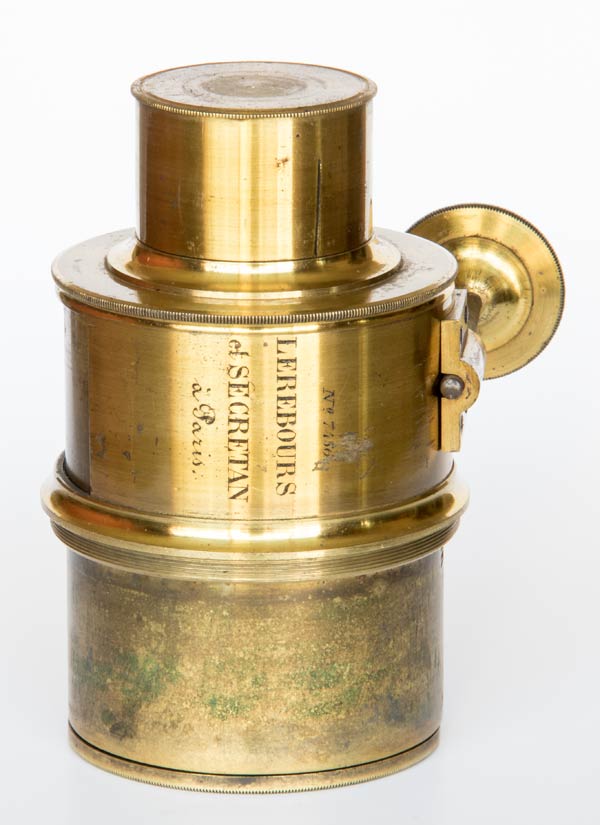
This objective sample, from Lerebours et Secrétan, is a lens of the Objectif Achromatique type, or objectif simple, objective for landscapes (paysage), or objectif pour vues, that would be objective for “sights”, a term probably coined by Niépce, who used it in his writings . All this meant that it was a lens for static subjects such as landscapes or architecture because the aperture needed to give sharpness across the field was very small and therefore the exposure times too long for the processes of the time.
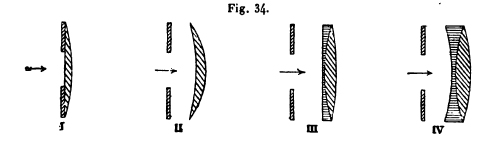
In the diagram above, taken from Etiene Wallon’s 1891 optics treatise, this landscape lens corresponds to scheme IV. It features a biconcave flint glass cemented to a biconvex crown. Schemes I and II were typical of camera obscura and III was used in the first daguerreotype cameras. By having this type of construction and by the serial number, engraved just above the name, No. 7456, this lens must have been manufactured around 1855.
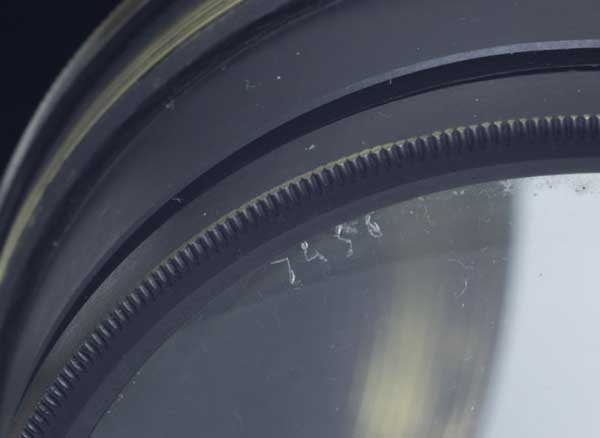
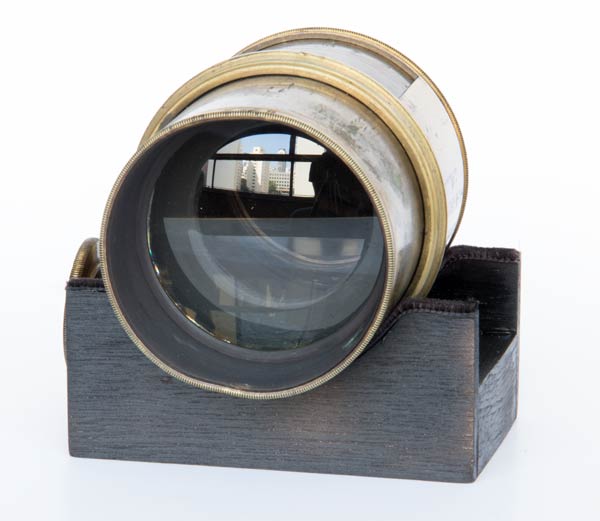
A curiosity about Lerebours et Secretan lenses is that in addition to engraving the serial number on the brass barrel, the manufacturer took the care of marking it also on the lens itself, as seen in the photo below.
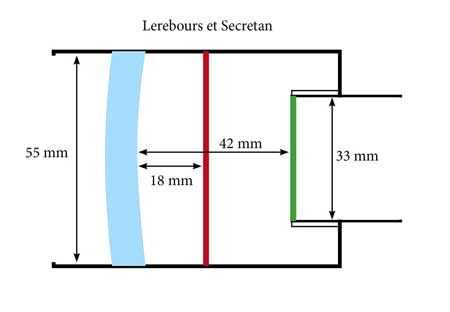
The basic dimensions of this lens are shown in the diagram below. It has two particularities. The first is that the doublet is like in a recess into the lens tube. I wondered, why would anyone do that? This part inside the camera! My hypothesis is that the intended effect was to give more room to slide the lens forward through the rack by stretching tube without moving the lens in relation to the diaphragm. I imagine it has been designed for a camera with less mobility for focusing leaving all movements to the rack. The 33 mm trip allows one to focus from infinity to a distance of only 2.2 m, probably more than enough for a lens like this. This would allow one to use it on a camera even without bellows or “drawer” system. Maybe it was designed for a fixed camera, a simple box. The other particularity, which is harder to explain, is that on top of the regular front tube where washer diaphragms are installed, this lens also a slit for Waterhouse type stops at 18 mm from the lens. I believe this must have been a later adaptation of some creative former owner. It must not be original from factory.
But at least the work was done with great zeal and looks even original. Both the cuts and the insert to support diaphragms are very well made. But I have found nothing in the existing literature to corroborate this kind of duplicity of diaphragms.
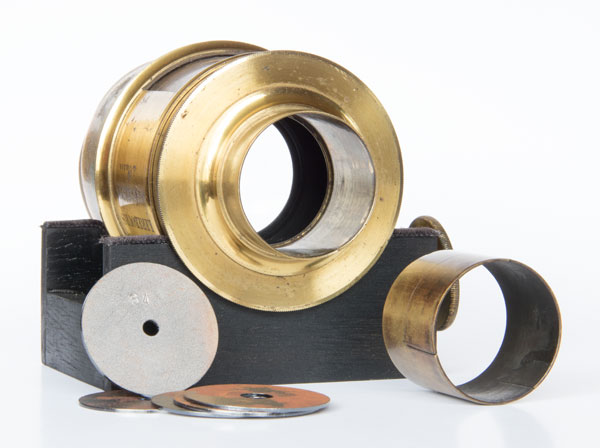
In this type of lens, the diaphragm is selected by inserting a washer into the tube in front of the lens. A metal piece (on the right), which fits tight into the same tube, holds the diaphragm securely in place. The cap, shown in the first photo of this article, was usually used as a shutter because times were very long. Used without any diaphragm the aperture of this lens is f / 7.7. But this should be a situation just to focus on a slightly brighter image. Apertures in practice should be f/16 or smaller.
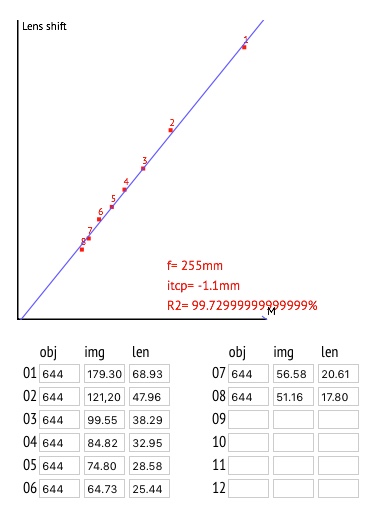
The focal length was evaluated by successive measurements of magnification that were plotted in the chart above (see calculator in this link) and the result was 255 mm. This is consistent with the lens diameter having 55mm because at that time they used to have a diameter of 1/5 of the focal length, according to Wallon and also Monckhoven. As for the position of the diaphragm in relation to the lens, a matter that was much debated at the time, it is known that the standard 1/5 of the focal length was adopted by most manufacturers for this type of lens. In the above diagram is marked 42 mm, that was measured to the surface of the lens. This should correspond approximately to 50 mm, at some point inside or near the doublet, and would then give us 1/5 of the focal length.
Using this lens
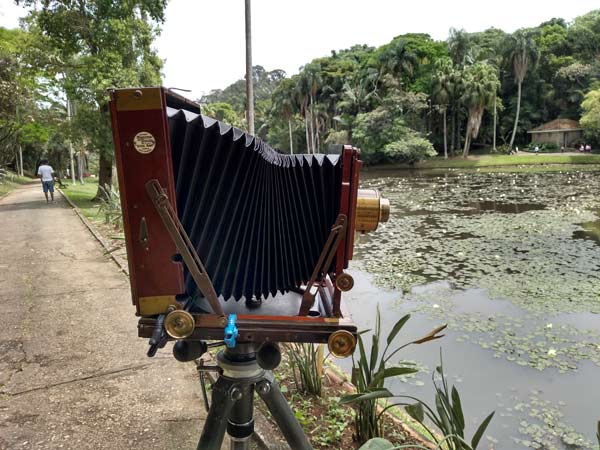
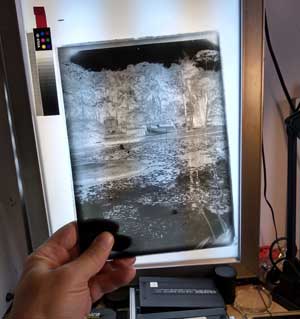
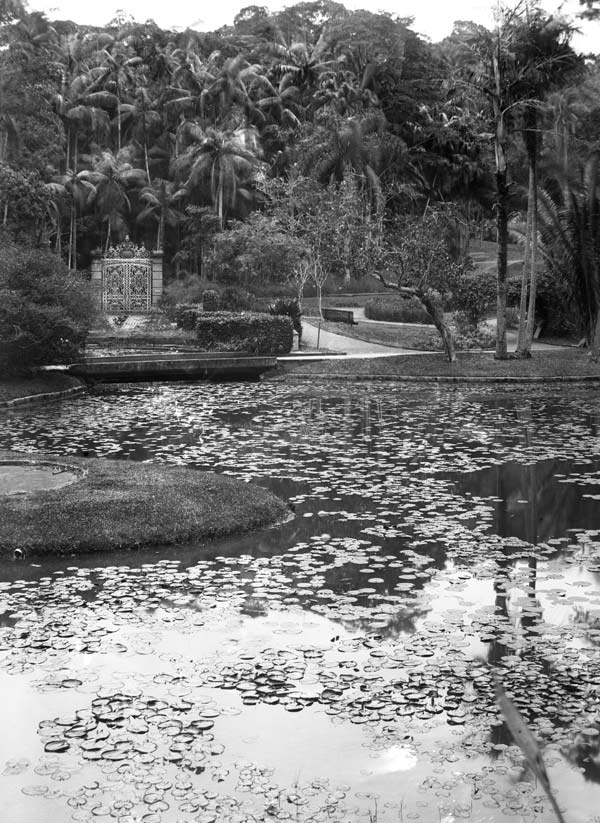
The photo to illustrate the use of this lens was made at the Jardim Botânico de São Paulo. It was mounted on a Thornton Pickard Royal Ruby whole plate camera: 18 x 24 cm. Instead of film, I took advantage of the fact that I’m testing home-made dry plates with silver gelatin, and it was then a 2-mm glass emulsified with the basic recipe of Joseph Maria Eder in his 1883 book.
This was the third batch of emulsion I prepared and the result was already quite satisfactory, keeping the natural limitations of the formula. On the left the appearance of the plate after it was developed. To take the photo I used a set of cut diaphragms for this lens as I don’t have the originals. The aperture chosen was f / 45 and the exposure time was 3 minutes on a day partly cloudy but very bright. The photometry for ISO 3 gave 30s at f / 45½ with an EV = 6.6. I deliberated increased exposure as the scene was basically green ant the emultsion is not sentitive to that color. The develpment was 12 min in Parodinal 1:20 at 20 ° C. It is possible to notice a vignette at the corners of the plate. I did not find this lens in the Lerebours et Secretan catalogs I could find, so I do not know what the official format recommendation would be. I think it would be half a plate because its circle of image is 25 cm and to be whole plate of the time (16 x 22 cm) would have to be at least 27.2. Being a lens for architecture and landscapes, one should have some freedom of movement.
I still can not get rid of flaws and stains on the dry plate. The image below is a direct scan of the negative but has been cropped and retouched to eliminate blemishes in the emulsion and spots from the development.
The result surprised me. We see in museums images made at the time and they are indeed very good. But this image is different from the historical samples because while the lens is old, the medium is fresh. I felt that the vintage photographs because they had already undergone a degradation of the material itself do not give a precise idea of what they must have looked like to those who saw them in their own time. I imagine that experiences like this can inform us a little more about the quality of the optics without the time influence on the printing itself. Of course, with f / 45 any lens has an obligation to look good, but even so, to think that already in 1855 had access to an image with that quality is something that always surprises, accustomed that we are thinking that everything must have greatly improved after such a long period of time.
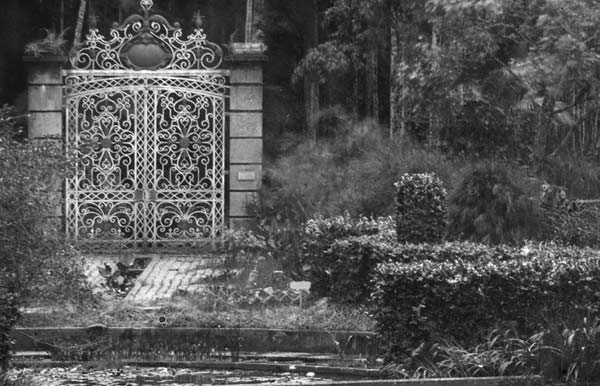
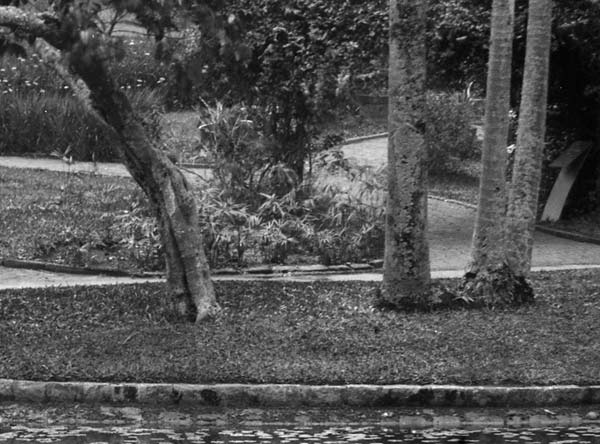
More detailed views of the same scan:
To finish, just as curiosity, a scan of a print by contact, on paper Ilford fiber, the entire plate and without croppings and retouchings. I looking forward to improve the emulsion in the next batches.
Additional reading
The story of the Lerebours is very interesting and illustrative of the transformations brought about by the 19th century. They represent the new mentality that shaped the current technological and industrial world. Photography completely embodied this shift in focus, and the Lerebours are a classic example. This is the subject of an article on Studiolo: The story of the Lerebours.
END-OF-ARTICLE-CHECK
5 Comments
There is an extensive list of surviving L & S (both landscape and portrait Petzvals) lenses on page 6 of this LargeFormatPhotographyForum article.
Hello. I am researching a photographic project of 1853. Gustave Le Gray apparently mainly used the Lerebours and Secretan lenses, according to his written pamphlets. This project entailed photographing murals in situ in the Galerie des Fetes in the Hotel de Ville, Paris. These murals, approx. 6 foot tall, were approximately 30 to 35 feet from the floor of the hall. The final photographs taken of the murals were large: approx. 14 x18 inches. Were there lenses at that time long enough to have allowed Le Gray to take photographs of the murals from the floor level? They would be very long lenses, I would assume. It’s also possible that he photographed from ladders or scaffolds…..Thanks for any help in this research….If you would like to see the photos please go to YouTube and search for “Lost Murals Le Gray” and you will probably find a video presentation…..
Hello, one important information is missing there. In order to simulate which lenses would be suitable for such project, it is important to know how far from the murals could the camera be positioned. Long lenses were never a big problem. The short ones, capable to embrace a wide angle, these are the tricky ones. In architecture, the wide angle lens is quite often requested as the photographer normally find a obstacle, like the other side of the street, and can’t get far enough to use a regular lens. If you can provide me the available distance from subject to camera, I believe I can calculate what sort of lens would fit better.
A most interesting and informative post with lots of factual data. Great photos! I have one L&S lens, probably a Petzval whole plate. Almost no depth of field when shot wide open, low contrast but sharp.




There is an extensive list of surviving L & S (both landscape and portrait Petzvals) lenses on page 6 of this LargeFormatPhotographyForum article.
https://www.largeformatphotography.info/forum/showthread.php?63733-Lerebours-Serial-Number-Rice-Writing
I have just added your traditional Landscape lens to the list!
What a fine, balanced and informative article this is!
Hello. I am researching a photographic project of 1853. Gustave Le Gray apparently mainly used the Lerebours and Secretan lenses, according to his written pamphlets. This project entailed photographing murals in situ in the Galerie des Fetes in the Hotel de Ville, Paris. These murals, approx. 6 foot tall, were approximately 30 to 35 feet from the floor of the hall. The final photographs taken of the murals were large: approx. 14 x18 inches. Were there lenses at that time long enough to have allowed Le Gray to take photographs of the murals from the floor level? They would be very long lenses, I would assume. It’s also possible that he photographed from ladders or scaffolds…..Thanks for any help in this research….If you would like to see the photos please go to YouTube and search for “Lost Murals Le Gray” and you will probably find a video presentation…..
Hello, one important information is missing there. In order to simulate which lenses would be suitable for such project, it is important to know how far from the murals could the camera be positioned. Long lenses were never a big problem. The short ones, capable to embrace a wide angle, these are the tricky ones. In architecture, the wide angle lens is quite often requested as the photographer normally find a obstacle, like the other side of the street, and can’t get far enough to use a regular lens. If you can provide me the available distance from subject to camera, I believe I can calculate what sort of lens would fit better.
A most interesting and informative post with lots of factual data. Great photos! I have one L&S lens, probably a Petzval whole plate. Almost no depth of field when shot wide open, low contrast but sharp.
Wonderful article, enjoyed reading this very much … I have a few similar lenses and we seem to enjoy the same books !
Cheers !
Rudi A. Blondia