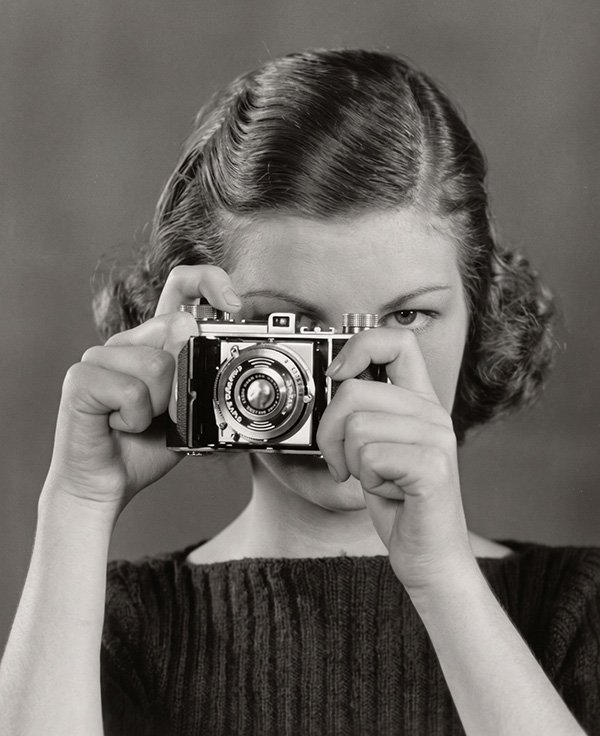
Kodak Retina 117 | Kodak AG
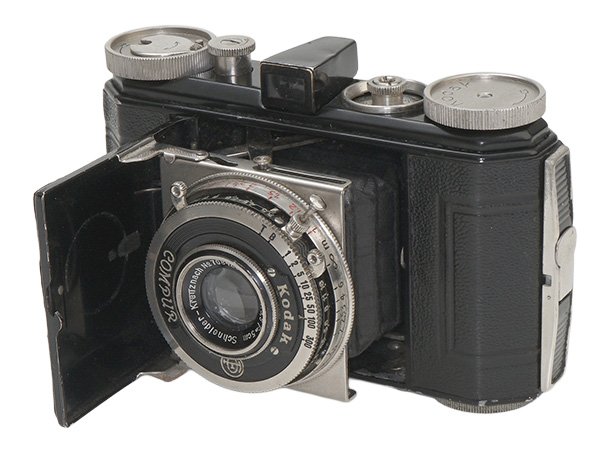
This model is the first in a long series of Retinas, which eventually led to an SLR version—the Retina Reflex —in the late 1950s. The long lineage began in 1934 with this Retina, codenamed 117. Since it is a 35mm camera, it is impossible not to compare it to the Leica, which hit the market nine years earlier, in 1925. The parallel arises because both were aimed at the same audience: an amateur yet sophisticated photographer who was also looking for practicality.
The Retina 117 is a very rugged camera—small but feature-rich—with a speed range from T and B to 1/300 s on a Compur shutter, apertures from f/3.5 to f/16, and excellent lenses: Schneider Xenar or Kodak Anastigmat f/3.5. These lenses are based on the Zeiss Tessar design .
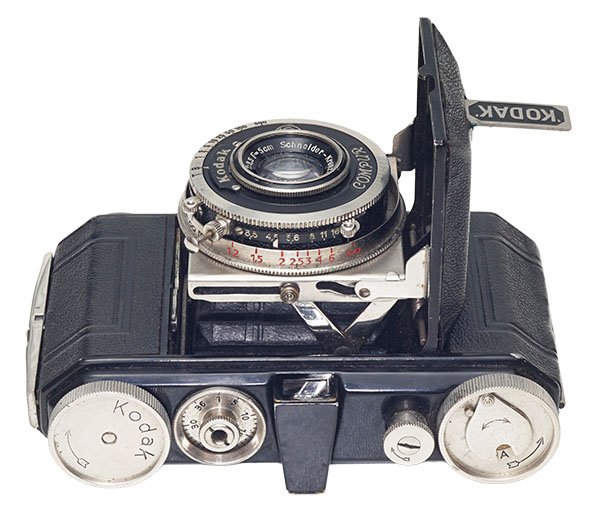
It’s interesting to note that, although this camera is a Kodak—from the American giant based in Rochester—its entire DNA is German. In the 1920s and 1930s, the trend toward miniaturization and the transition from sheet film to roll film was well underway. While Kodak was raking in millions in the box camera segment with models like the Brownie and its folding and pocket cameras—which served as entry-level options for amateur photography—it saw the emergence of a segment of more sophisticated cameras aimed at an “advanced amateur” audience. Companies like Zeiss Ikon, Voigtlander, and especially Leitz, with its Leica, were well ahead in meeting this new demand, but Kodak wanted to venture into these waters as well.
That is how Kodak’s European management began searching for and negotiating with German companies to open a manufacturing division capable of expanding its production in that direction. The move made sense from a financial standpoint, as Germany at the time had a very competitive labor market (due to postwar crises). Low costs combined with cutting-edge technology made it a logical choice.
In 1932, Frank Lovejoy, who was in charge of Kodak’s German subsidiary, completed the acquisition of Nagel Fabrik für Feinmechanik in Stuttgart. Dr. August Nagel was one of the founders of the massive merger that had resulted in the giant Zeiss Ikon in 1926, but as early as 1928 he decided to strike out on his own and started a boutique precision camera manufacturing business. It was the perfect match. What he lacked was capital and distribution power—two areas where Kodak was likely the strongest player in the industry.
Following the acquisition, Nagel’s product portfolio—which included Recomar, Vollenda, and Pupille cameras—continued to be marketed and underwent only a rebranding to the Kodak brand. But the first project conceived and carried out to take full advantage of the synergies resulting from the acquisition was the Retina 117.
Back then, the company’s industrial design department was still generally the one calling the shots, and developments were often the result of the engineers’ idiosyncrasies rather than proposals born of a strategic vision that took the consumer market into account. The highly elaborate oddities that failed in the first few months of production and are now prized by collectors are the result of this kind of approach.
But the Retina 117 was born from a vision that started at the other end of the spectrum: it was conceived with a specific type of photographer in mind. It was a project designed to meet a very specific need. As mentioned above, Kodak AG intended to offer a camera to compete with Leica and Contax, but at a much more affordable price point. Its goal was to appeal to a segment of more sophisticated, more demanding amateur photographers who would not be willing to pay about four times as much for a Leica or Contax.
Across the Atlantic
The Retina was a two-part launch: along with the camera came an entirely new concept that would change everything in the history of 35mm film photography. Until then, all photographers wishing to use the 24 x 36 mm format on a roll of film originally designed for cinema—which Oscar Barnack so cleverly adapted for photography as well— had to buy film in bulk, by the meter, cut it, and load it onto metal spools that were then inserted into the camera.
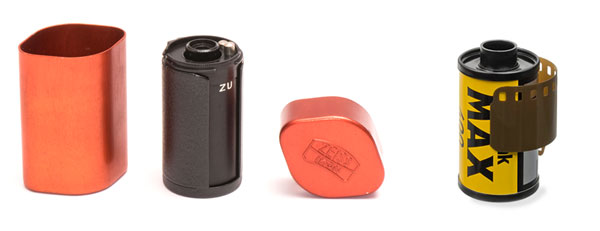
When Kodak launched the Retina 117, it began offering film pre-spooled on reels ready to be inserted directly into the camera. This is the standard everyone is familiar with. It’s practically synonymous with “film.” Above, we see, sided by its little red metal case, an elegant reusable spool from Zeiss Ikon, designed to hold film purchased by the meter, and on the right, a Kodak spool with the film already inside.
To be precise with the terminology, we need to clarify that the disposable cartridge refers to 135 film. Inside it is 35 mm motion picture film, perforated on both sides. In other words, 135 is a code that refers to 35 mm film that has already been loaded into a disposable cartridge.
Needless to say, the standard was adopted worldwide, and although some new releases took a chance on using specialty spools like Robot or Agfa Karat, 135 film reigned supreme. Ironically, starting in 2020, with the clear growth of analog photography—now a niche market rather than mainstream—there has been a greater interest in rewound film because it is much less expensive than 135 film. Reusable spools are available for purchase, but above all, the once “disposable” spools—which used to be thrown away by the millions—are now recovered, carefully opened, and reused multiple times.
The name
Where Retina definitely outshines Leica or Contax is in its name—at least in terms of the richness of its meaning and associations. Leica is nothing more than “Leitz+ Camera,” which is quite mundane. Contax originated from a contest among employees, and although one could argue that the “Con” comes from “contact”—which would refer to the photographer’s closeness to the subject—nothing embodies the new era of photography ushered in by 35mm cameras better than the name Retina.
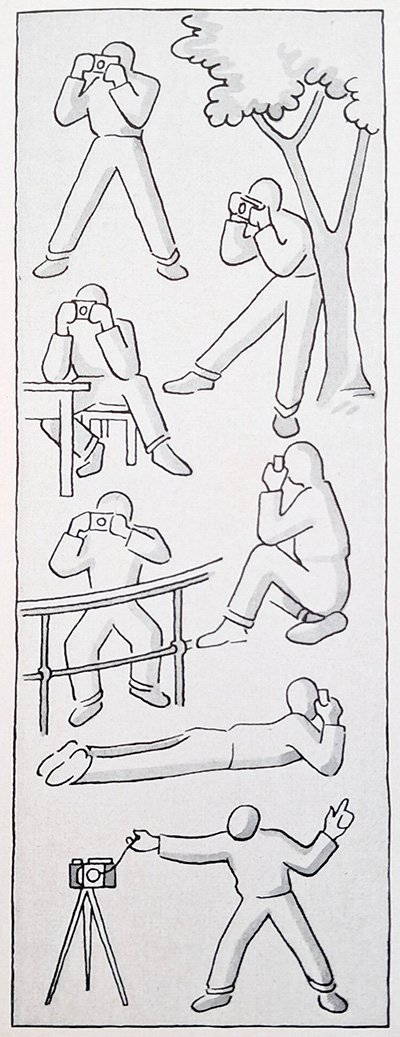
The illustration above is from the book *Das Retina Buch* (Dr. Otto Croy, 1956). It demonstrates what the innovation of a small camera with a direct viewfinder allowed the photographer to do. Since the dawn of photography in 1839, there has been much discussion about the relationship between the photographer and his subject. The scientists involved in the discovery emphasized—perhaps even too much—that photography would be the “pencil of nature,” as Henry Fox Talbot coined the phrase. He even wrote that his “house”—an old abbey in Lacock, England—would be the first building to make its own “drawing.” It was as if objects were taking selfies, and the photographer—who was more commonly referred to simply as an “operator”—had virtually no influence over the process.
In the 1850s, when there was a major debate over whether photography could be considered an art form, the argument of those who did not see it that way was that it was a mechanical process involving no real participation by the “operator.” It was a scientific, objective process, leaving no room for the photographer’s subjectivity. Of course, this is an extremely reductionist view and does not correspond to the reality of the practice. But the fact is that cameras and photographic processes did indeed lead to a high degree of standardization, to a supremacy of the object that dictated the nature of the photograph. The static scenes and the orthogonality of the lines were, as it were, constraints with which the photographer had to come to terms. If he wanted to use photography as a form of self-expression, these were variables that were practically fixed to him.
With the introduction of faster lenses and dry plates around 1880—which used gelatin as a base—new cameras incorporating these features opened up new degrees of freedom. Detective cameras emerged, featuring a viewfinder and 12 plates, as well as the Kodak No. 1 with roll film and miniatures such as the Block-Notes. All these innovations gave photographers more choices, more framing possibilities, a wider range of subjects to choose from, and more ways to influence the final image.
In this sense, Leica—the great icon of modern photography—was not a radical break. It was a milestone in a long evolutionary journey toward flexibility in photography. But it was Kodak, with its Retina, that earned the credit for embodying in its very name that spirit so long sought after. “Retina” is a word that categorically affirmed that photography is not about the subject, nor is it about the camera—it lies in the photographer’s gaze, in his retina.
In use
It’s a camera that gets to the heart of photography, where even the most sophisticated models must still come down to the basics: shutter speed, aperture, and focus. Focus is set manually using a scale in meters. This intimidates a lot of people, but it shouldn’t. With a little practice, one can achieve very good results. It’s best to focus on portraits (half-body shots at most), group shots, and landscapes. It’s great for street photography.
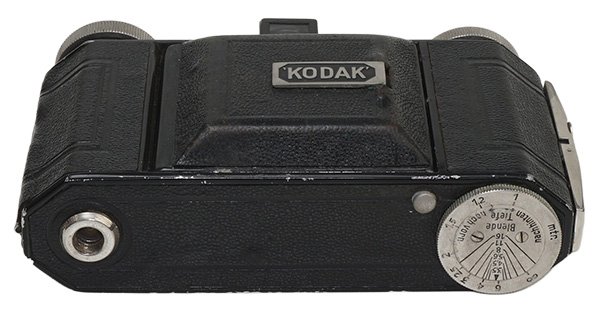
When closed, it’s very small. Given its size, its 445g weight is a bit surprising—it feels heavy, since we’re used to plastic and this one is made entirely of metal. At the same time, this gives it a solid feel and really helps keep the camera steady; its extremely quiet Compur shutter also contributes greatly to stability—there’s no impact.
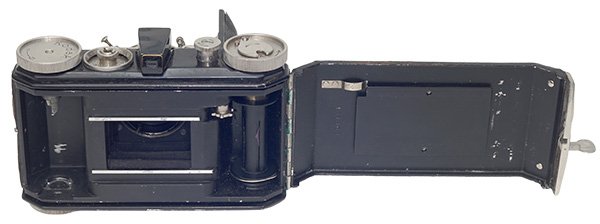
Advancing the film does not cock the shutter, so this requires a bit of attention. When advancing the film, there is a lock that must be released to move on to the next photo. It has a frame counter. It’s very simple but solidly built. If treated with care, this camera will last forever.
Descendants
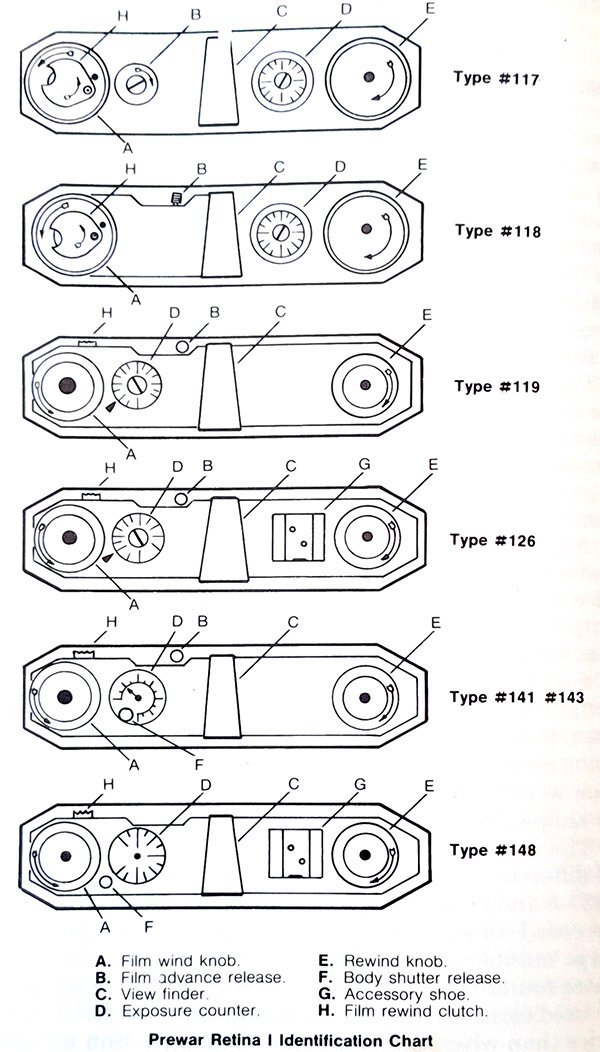
Dr. August Nagel continued to refine the design, and new models were introduced with more ergonomic features and controls, such as the shutter release button on top of the camera, starting with the 1937 Kodak Retina 141 model. The chart above provides an overview of the models up through World War II.
Although several details changed during this period, the basic design remained the same. A completely new design emerged in 1951 with the Retina II, Type 016, and Type 015. These were already cameras with lever-operated film advance and even a rangefinder (as in the case of the Retina IIa 016). In 1954, a redesign introduced a new chassis block, followed later by the Retina Reflex SLR.
Legacy
Compared to Kodak’s sales in other, more popular segments—and even compared to competitors in the same segment—the Retinas were not a huge success. Across the entire series, 2.5 million cameras were sold over the course of about 25 years. Although they were of unquestionable quality and had a very appealing design, it seems that the folding concept with leaf shutter had already become outdated by the 1930s.
It is true that a photo taken with a Leica from the same period using a 50 mm Elmar lens, when compared to a photo taken with a Retina using a 50 mm Xenar lens under the same conditions, will not put the latter at a disadvantage by normal standards. But the fact is that the Leica allowed for lens changes, it had a rangefinder linked to the focus adjustment, it cocked the shutter when advancing the film, and offered a number of other operational advantages that, taken together, made a huge difference in perceived value for the brand—even for a photographer who used only the 50 mm f/3.5 Elmar lens.
Kodak had enormous financial resources and distribution power, but it was the brand of “point-and-shoot” cameras—those box cameras that were sometimes sold as children’s toys. Other brands, such as Leitz, Zeiss, Voigtlander, and later Exakta, had a different history, with a tradition in the premium market. This likely also influenced the preferences of the advanced amateurs for whom the Retinas were intended.