Kodak No. 1 | The Eastman Dry Plate and Film Company
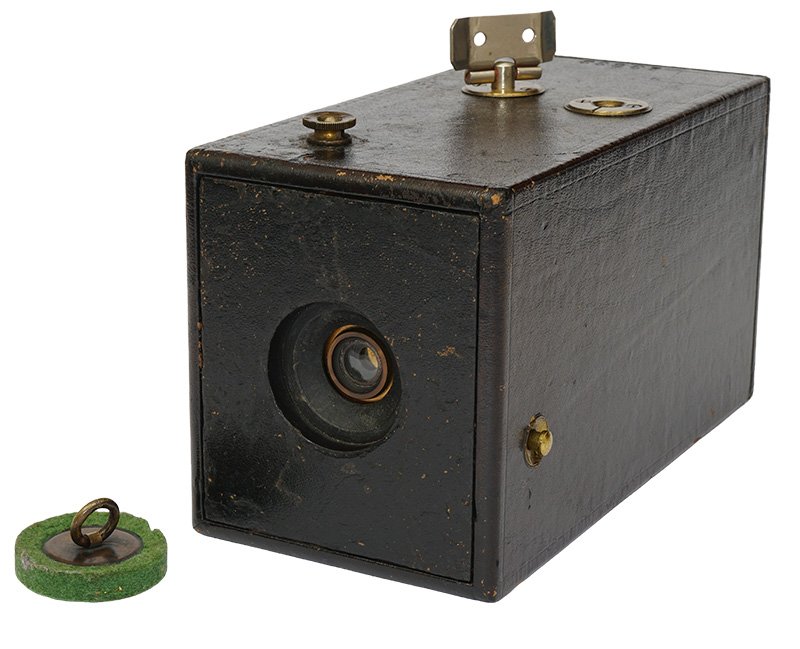
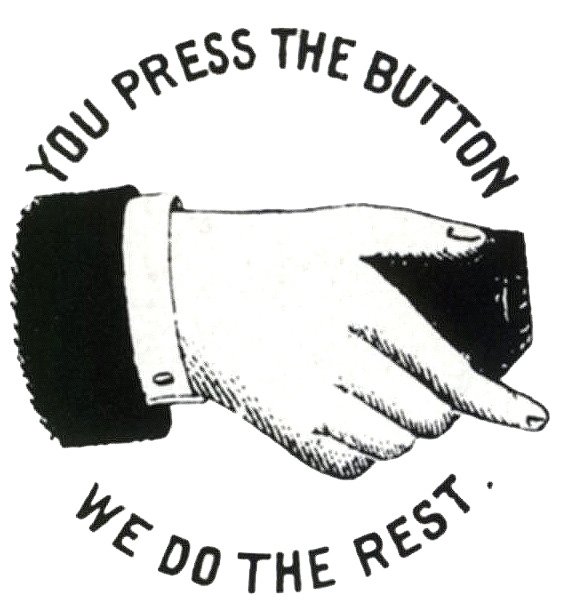
Few cameras can be considered milestones that marked a profound change in the history of photography. The Kodak No. 1 is certainly one of them. It was for this camera that George Eastman coined the name “Kodak,” and it was for this camera that he created the slogan “You press the button, we do the rest”; it was the first commercially successful camera to use flexible film on rolls instead of glass plates; and it was with this camera that photography ceased to be the preserve of enthusiasts and became part of the daily lives of people who had never even been interested in photography before.
Glass or paper, sheet or roll.
Photography began on metal, on the silver-plated copper plate used in daguerreotypes. But almost simultaneously, the negative/positive process on paper emerged, followed by the wet plate on glass.
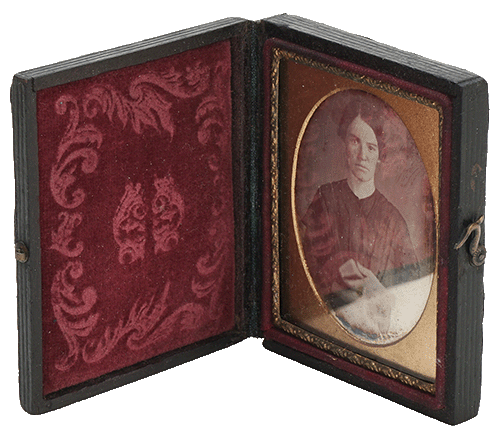
Paper was practical because it was lightweight and did not break like glass, but due to its fibers it was not possible to capture the extremely fine details found in the daguerreotype. Even the daguerreotype was soon abandoned and replaced by wet collodion plates. Glass wet-plate negatives were generally printed on albumen paper and also produced photographs with a level of definition that remains impressive to this day.
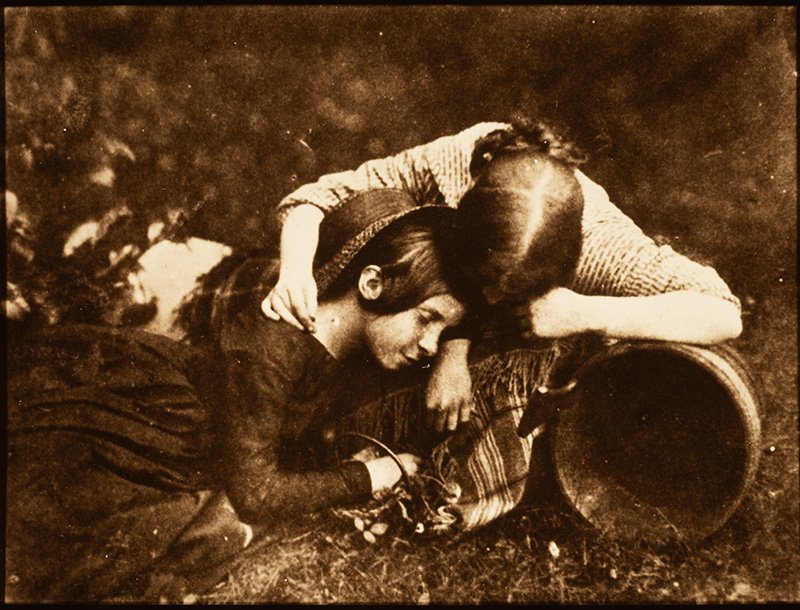
Hill and Adamson (1843–47)
For about 30 years, collodion reigned supreme as a medium for producing negatives and even direct positives, as was the case with ambrotypes and ferrotypes. But the glass had to be coated with the emulsion just moments before the plate was exposed, hence the name “wet plate.” This only changed in the 1880s, when dry plates sparked a new revolution.
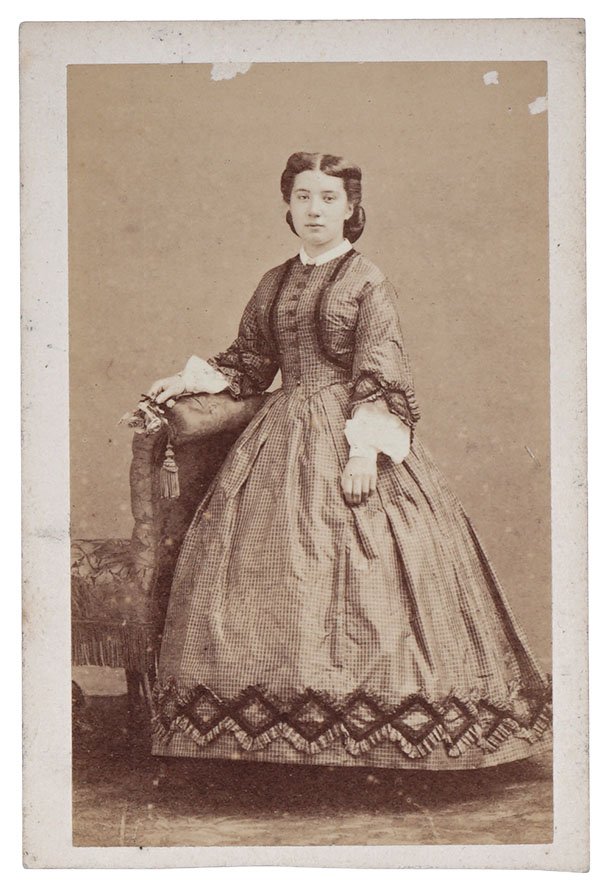
Photographer: André Adolphe-Eugène Disdéri.
The dry, gelatin-based plates could be stored for use for up to several months after production. The manufacturing process allowed for more effective control. Thus, for the first time, it became possible to mass-produce photographic media for negatives, and soon brands began to appear on the market, sold in specialty stores.
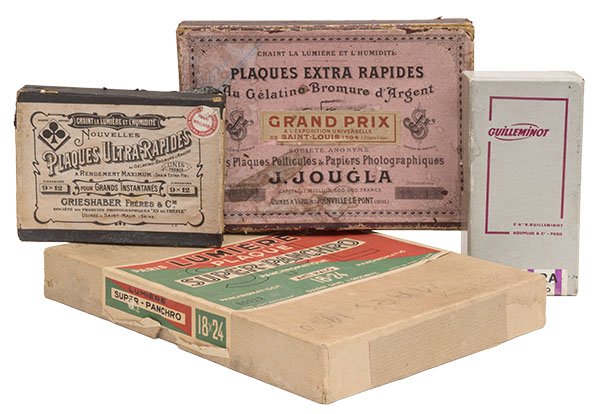
Flexible media
In 1878, George Eastman was 24 years old and working at a bank. That was when he became interested in photography. He bought a wet-plate kit and also experimented with dry plates. Fascinated by the process, he began making his own emulsion. During the day he worked at the bank, and at night, in his mother’s kitchen, he experimented with formulas and methods for coating the plates. After three years of this home-based operation, he partnered with Henri Strong to take a bigger step and rented a space in his hometown of Rochester. That became his first factory. By 1883, they were already occupying a four-story building.
Sales were going well and allowed him to invest some of his time and resources in innovation. He focused his research on finding alternatives to the glass plate. Together with William Walker, he patented and launched an interesting accessory that used paper as a support for the negative.
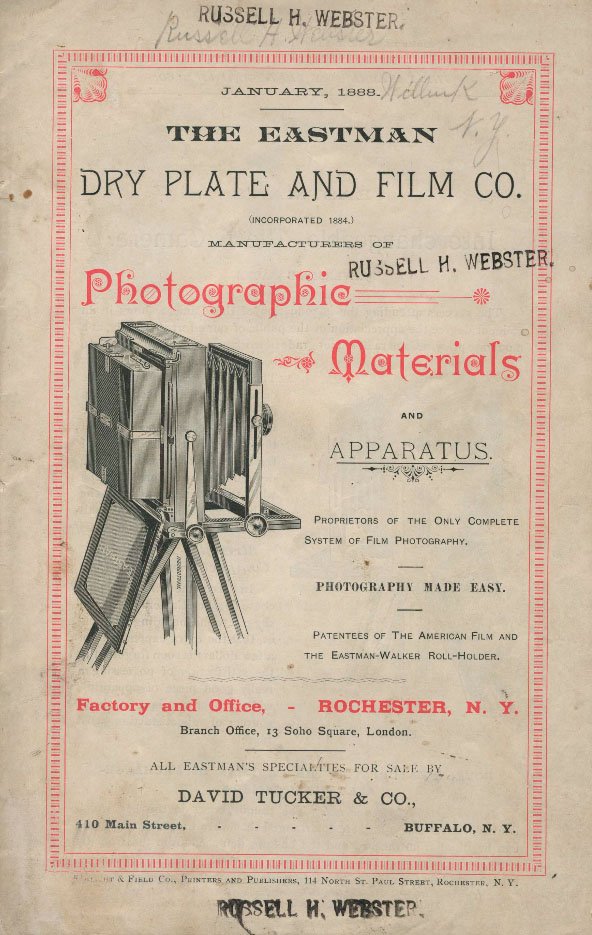
It was an adapter— the Eastman-Walker Roll-Holder— for those who owned studio or field cameras, as shown in the image above. This accessory looked like a box that fit perfectly onto the mount of a traditional plate holders and allowed the camera to be equipped with a roll of paper negatives capable of taking up to 24 photos without needing to be reloaded.
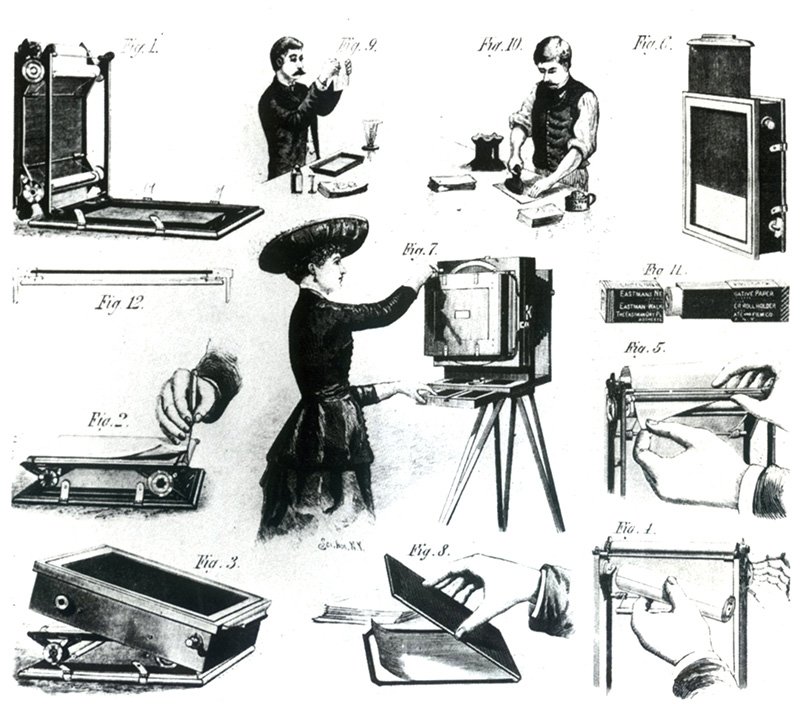
Although the initiative was highly praised, the device was not a commercial success because the base was still paper. Part of the process involved applying castor oil to improve transparency (shown in Fig. 10 in the illustration above), but even so, when compared side by side, the prints made from the glass plates were far superior in clarity and detail.
However, almost by a stroke of luck, attention was drawn to an advantage where the roll film system proved unbeatable. It was in Paris, in 1886, where the photographer Nadar conducted an interview with Michel Chevreul. The event was turned into a photo essay. Paul Nadar, son of the celebrated photographer, was Eastman’s representative in France and used one of these roll-film backs to take more than a hundred photos on paper film while his father interviewed the distinguished scientist.
What all photographers surely realized was that simply turning a knob to move on to the next photo was much more practical than changing a plate holder. The number of shots taken was considerable, and they allowed Paul Nadar to capture snapshots that truly told the story of the interview.
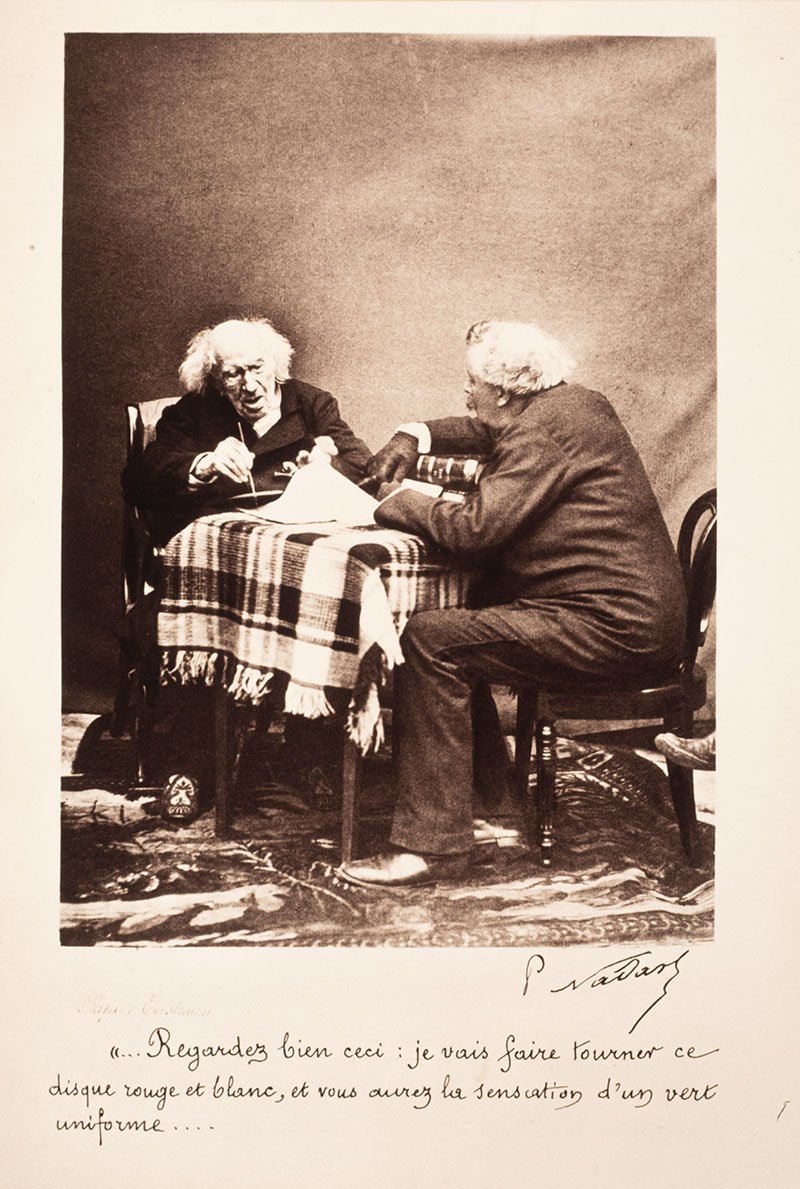
This is one of the photos from the interview.
However, as can be seen in the photo above, the finer details were lost because the paper fibers acted as a diffusion screen, and simply adopting the new roll-based medium was not enough to make the launch profitable.
The American Film
In 1884, George Eastman found a way to combine the flexible, lightweight medium of paper with a transparent material capable of rivaling glass. He called the new product “American Stripping Film.” The idea was ingenious but complicated.
A layer of water-soluble gelatin was applied to the paper base. A layer of collodion was applied over this gelatin, followed by another layer of gelatin, this time prepared as a photographic emulsion. This process was used to make rolls as well as sheets.
The problem was the subsequent processing of this film. It was carried out in the following steps:
- After exposure, the roll of film went through the standard development process, including the developer, stop bath, fixer, and rinse baths. This was done with cold water to prevent the gelatin base from dissolving.
- Next, the film was placed on a glass plate with the emulsion side facing down. Warm water or steam was applied to the paper, causing the soluble gelatin to soften, and the paper was carefully removed, leaving a thin layer with only the emulsion exposed and developed on the glass.
- A new, thicker layer of gelatin with a setting agent was spread to form a thicker film
- Once it was removed from the glass and dried, this translucent film with the negative image was ready for contact printing or enlargement.
The key concepts of the process were not new.:
1) a flexible support mounted on a roll
2) the use of gelatin or collodion as the emulsion base
It seems that everything had already been tried at that time, and it is very difficult to say who was the first. However, the reliability and resulting practicality of use left much to be desired among most other inventors and manufacturers. The merit of The Eastman Dry Plate and Film Co. lay more in having arrived at commercially viable solutions than in pioneering the field per se.
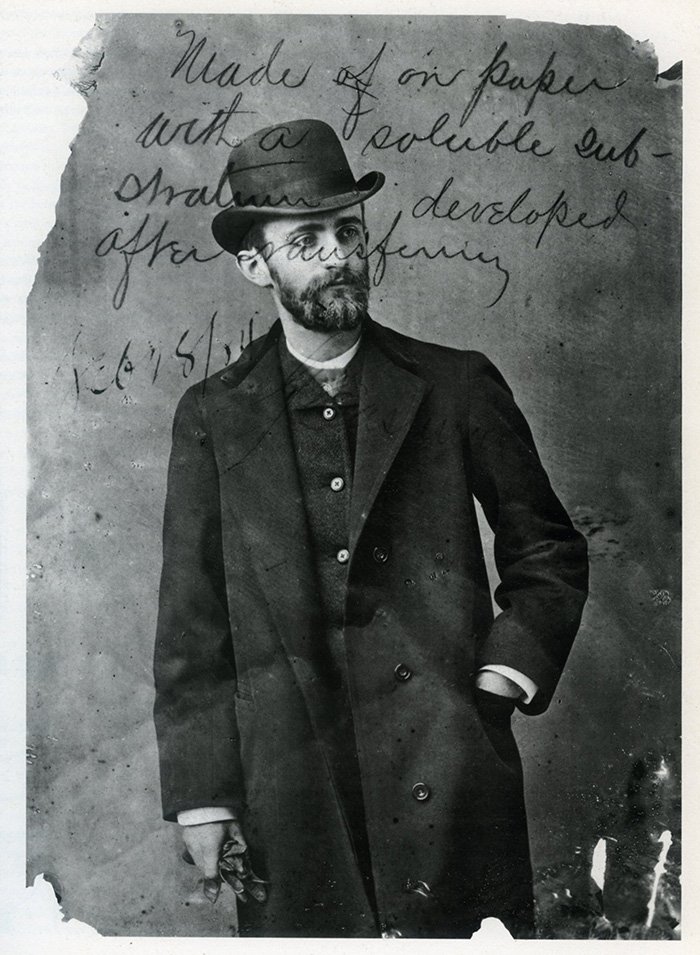
The photo above is a self-portrait of George Eastman taken while he was developing his American Film. You can clearly see the different textures of the various fabrics, as well as the transitions in dark areas, something that would be very difficult to achieve on a paper negative. The handwritten note reads: “Made on paper with a soluble substrate and developed after transfering.” This was certainly an experiment, while in the final process, development would take place before the transfer, as mentioned above. Another thing to note is the imperfections along the edges of the photograph. Removing the paper was a very delicate operation because the gelatin layer was very thin. In the upper corners, one can clearly see that the gelatin is present but did not adhere on the right place to the new base. This proved to be an insurmountable obstacle for most photographers.
In 1886, the company’s product line included dry glass plates, sheets, and rolls of paper for negatives using the traditional process, the recently developed American Stripping Film, backs for adapting rolls to cameras from other manufacturers, papers for positives, several photo gadgets and also offered photographic printing services with enormous enlargements reaching up to 54 x 90 inches (137 x 228 cm).
Despite the product launches that did not lead to sequels—which were commercial failures—the company as a whole was doing well and growing thanks to the more traditional products in its lineup.
Cameras
It was around this time that the Eastman Dry Plate and Film Co. began venturing into the camera market as well and produced a few large-format view cameras that used dry plates or a roll-film back. But what George Eastman had in mind was something more portable and easier to operate. His attention turned to the growing market for detective cameras.
These were cameras not necessarily used by detectives. They basically eliminated the need for a tripod and for ground glass. They were made possible by new, faster lenses with a wide angle of view, around 50 to 60 degrees. Another crucial factor was the rapid development of dry plates. For framing, they used a viewfinder, and for focusing, a distance scale that had to be estimated and adjusted by the photographer. With all this portability—which would have been impossible ten years earlier—they allowed for discreet, covert photography, hence the somewhat fanciful association with the work of detectives.
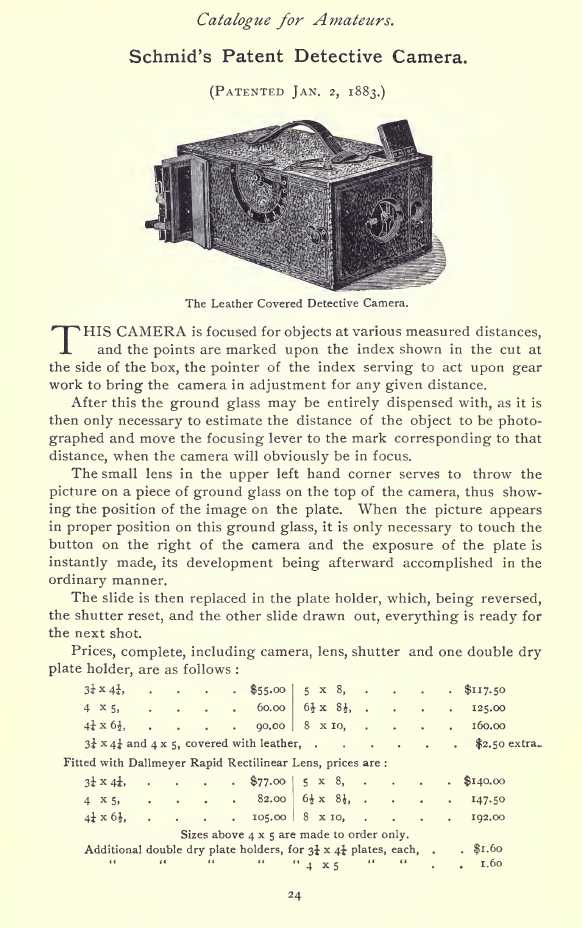
George Eastman realized that these cameras were much more practical than traditional view cameras, with their ground glass, bellows and tripod. In partnership with Franklin Cossit, he designed a detective camera ( US . Patent No . 353545A), of which they manufactured only about 50 units before abandoning the project.
The Eastman/Cossit camera used a Rapid Rectilinear -type lens that could be focused using a distance scale. It had a shutter that allowed for variable speeds via a somewhat complex mechanism, similar to a focal-plane shutter; it allowed the use of dry plates but also came equipped with an adapter for American Film. All in all, the manufacturing cost was prohibitive, and what the camera offered was similar to that of dozens of others on the market.
The problem for all manufacturers entering the instant camera market is that the more features they added, and the more they tried to improve image quality, the more complicated the operation became and the closer the camera came to difficulties similar to those it was intended to replace, without having the absolute control that the traditional ground glass naturally offered. Only handheld photography remained as a distinguishing factor. But after decades of using a tripod and a black cloth, taking photos without them still seemed somewhat strange and rather pointless.
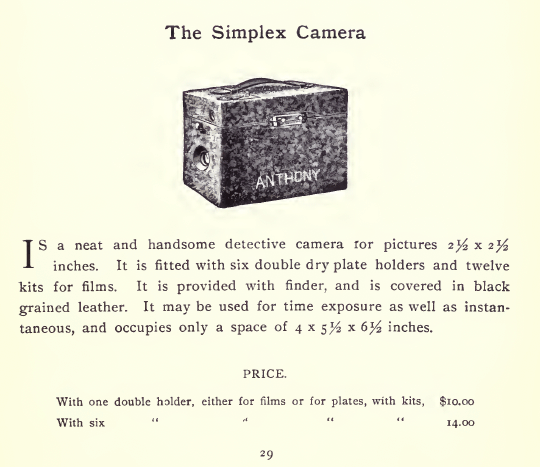
Some camera models were quite simple and had virtually no adjustment options, as the name of this Simplex model above makes clear. But even within this category, George Eastman soon realized that there was no distinguishing feature that would give him a significant edge over competition.
Devotees or Dabblers
In the 19th century, the term “amateur” was closer in meaning to what we would today call an “expert.” It referred to someone who truly studied and devoted himself to a particular activity, even if it was just a hobby. The etymological origin is “one who loves”. For these individuals, the photography market offered a world of options in cameras, lenses, accessories, darkroom supplies, and a wide variety of processes. And yet the amateur would add his or her own personal touch to all of this, as it was very common for them to prepare their own developers, additives, and accessories.
For those who, rather than “loving” photography deeply, simply wanted to “dabble” in it and take family snapshots—without much commitment and without many technical or aesthetic demands—there were cameras like the Simplex. But George Eastman—himself a very dedicated amateur who began his career as an entrepreneur in the industry, focused on the only market that truly existed, namely the professional market or that of serious amateurs like himself— realized in the late 1880s that there were also many, many potential “dabbling” photographers, and for them, it wasn’t so much the camera itself that served as the entry barrier to photography.
Between pressing the shutter button and having the finished photo in their hands, everything that had to happen in between was completely uninteresting to a whole host of people who, despite that, would still love to play at being photographers from time to time. It was even more than just “uninteresting”—it was tedious, expensive, difficult, and therefore more likely to be a source of frustration.
George Eastman must also have looked at his American Stripping Film, which had the practical advantage of being sold in reels and still produced very high-quality images, comparable to glass negatives, but whose process was labor-intensive, delicate, and prone to errors even for professional photographers. He certainly knew it would be pointless to load it into just any “Simplex” in an attempt to attract casual photographers, since they refused to set foot in the darkroom even for the traditional process, which was far simpler. As for professionals and advanced amateurs, he had already tried loading American Film into his sophisticated Detective Camera, and it hadn’t worked out. For those who weren’t put off by adjusting focus, exposure, or working in the darkroom, the vast majority would be better served by traditional equipment loaded with dry plates.
That’s when the big idea came—the idea of the century: to target the market of casual photographers—amateurs as we understand them today—but with two conditions: without bothering them with sophisticated cameras and completely freeing them from the hassle of a home darkroom. With the launch of the Kodak No. 1, the George Eastman Dry Plate and Film Co. began offering a full photo-processing service. The negatives were developed and printed at the factory in Rochester.
The radical change that this outsourcing of photographic processing represented led George Eastman to conclude that the new process called for a new concept that would be best conveyed by a new name.
The name Kodak
There was a general consensus that the name of a camera should be associated with something positive, superior, or distinctive, or else be highly descriptive and informative. The camera was, first and foremost, a precision instrument intended for use by professionals and very dedicated amateurs. In the 1880s, the leading manufacturers in the United States and the United Kingdom, guided by these principles, marketed cameras with names such as: The Ruby, The Universal, The Champion, The Perfection, as well as Multiplex, Stereoscopic, Panoramic, Detective, and Simplex.
In this context, it’s interesting to see how George Eastman didn’t worry much about following market rules and focused more on his audience’s direct relationship with his product. He dared to create a name that had absolutely no meaning. In September 1888, when he applied for formal registration of his trademark, he was asked about its origin or meaning.
“This is not a foreign name or word; I created it to serve a specific purpose. It has the following merits as a trademark:
First: it’s short.
Second: it leaves no room for mispronunciation.
Third: it does not resemble anything in the industry and cannot be associated with anything in the industry except Kodak.”
“Kodak” was, therefore, an empty yet simple word that could fit into any language. A word with no history in photography and thus ready to open an entirely new chapter in the history of photography. It was not the brand that would lend any meaning to the camera. Rather, the camera and the entire system surrounding it would give meaning to the word “Kodak.”
In fact, in a very short time, the initially bland term became so rich in meaning that it came to embody the company’s philosophy in areas such as universality, trust, ease of use, quality, family, vacations, and other concepts and values that the public spontaneously began to associate with the Kodak name.
A casual comment in The British Journal of Photography perfectly illustrates just how right George Eastman was in his branding strategy:
“Will the name ‘Kodak’ eventually become a generic term for detective cameras? We raise this question because we have, on several occasions, heard this term applied by laypeople to various types of detective cameras that in no way—whether in appearance or operating principle—resemble the widely publicized instrument. “(The British Journal of Photography — May 31, 1889)
Aware of this enormous achievement—which is, after all, every brand’s dream—George Eastman gradually set his own name aside, and Kodak became the defining name of the conglomerate that was taking shape.
Company Timeline Summary
1881: Eastman Dry Plate Company (founded by George Eastman and Henry A. Strong)
1884: Eastman Dry Plate and Film Company (renamed to reflect the invention of flexible negative film)
1888: The word “Kodak” is registered as a trademark and introduced as the product name for the first roll-film camera
1889: Reorganized as The Eastman Company
1892: It officially becomes The Eastman Kodak Company (the legal entity currently in use)
By 1892, the senseless word—which Eastman had coined four years earlier—had become so prevalent in the public consciousness that it had earned its permanent place at the company’s entrance.
The system
The Kodak No. 1 cost 25 USD in the United States and 5 pounds in England. It was by no means a cheap camera. It would be equivalent to a premium mirrorless camera today. It was sold pre-loaded with a roll of American Stripping Film, good for 100 pictures. Once the roll was finished, the entire camera was sent to Rochester, where the film was developed and printed. The prints were made by contact printing. The circular image had a diameter of 64 mm (2½ inches).
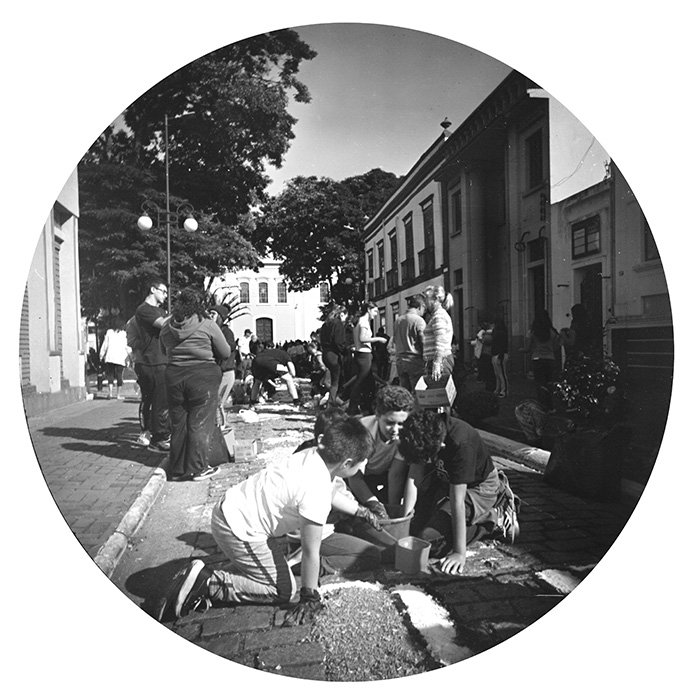
When the camera was returned, it was reloaded with another 100 photos and sent to the customer along with the prints from the previous roll. It was an instant success.
In 1890, just two years after the launch of No. 1, the Rochester lab was printing thousands of photos a day. A customer in the United States received their prints in 10 days on average. For European customers, however, the mailing time alone took two weeks. To maintain the momentum of the launch and avoid the risk of discouraging new customers, a processing branch was opened in Harrow in 1891, followed by others in continental Europe and even Australia.
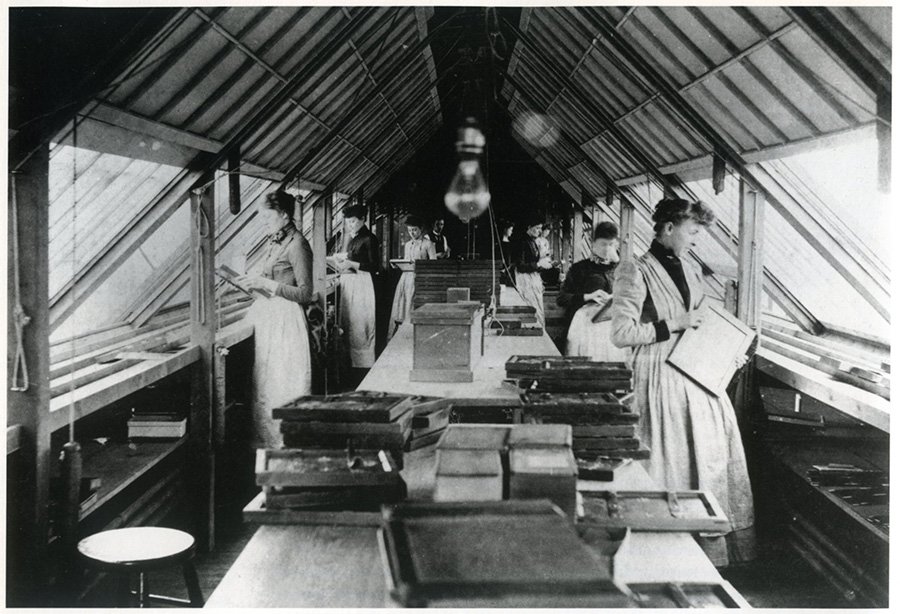
Source: The Story of Kodak by Douglas Collins
The printing was done on silver chloride paper; it was therefore of the POP (printing-out paper) type, which develops in daylight and reveals the image during exposure. For this reason, the printing rooms were equipped with large glass windows, as shown in the photo above. Interestingly, because this was a new technology and the handling of American Film required highly specialized expertise, the photo finishing network was fully verticalized under Kodak’s own structure, both in the United States and around the world.
The camera
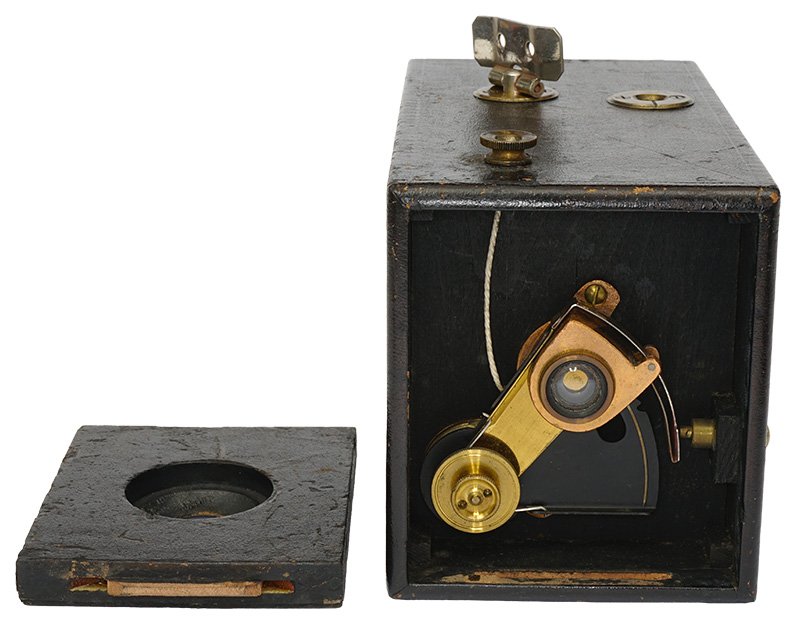
The Kodak No. 1 is made entirely of wood and lined on the outside with Morocco, a very fine goatskin leather that was commonly used at the time for luxury items. It is a box with a recess and a cover on the front to house the lens and shutter. A frame containing the film transport mechanism slides into the camera, closing the back.
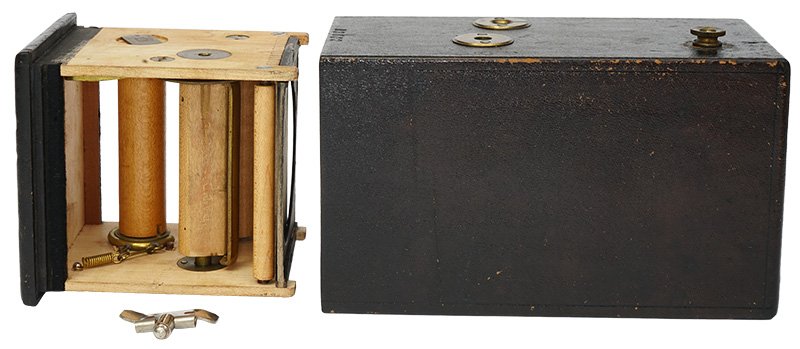
When the film is advanced, the lever does not lock, and the photographer should make sure that a pointer at the top of the camera, next to the lever, has made a full rotation to ensure that the film has been advanced the correct amount.
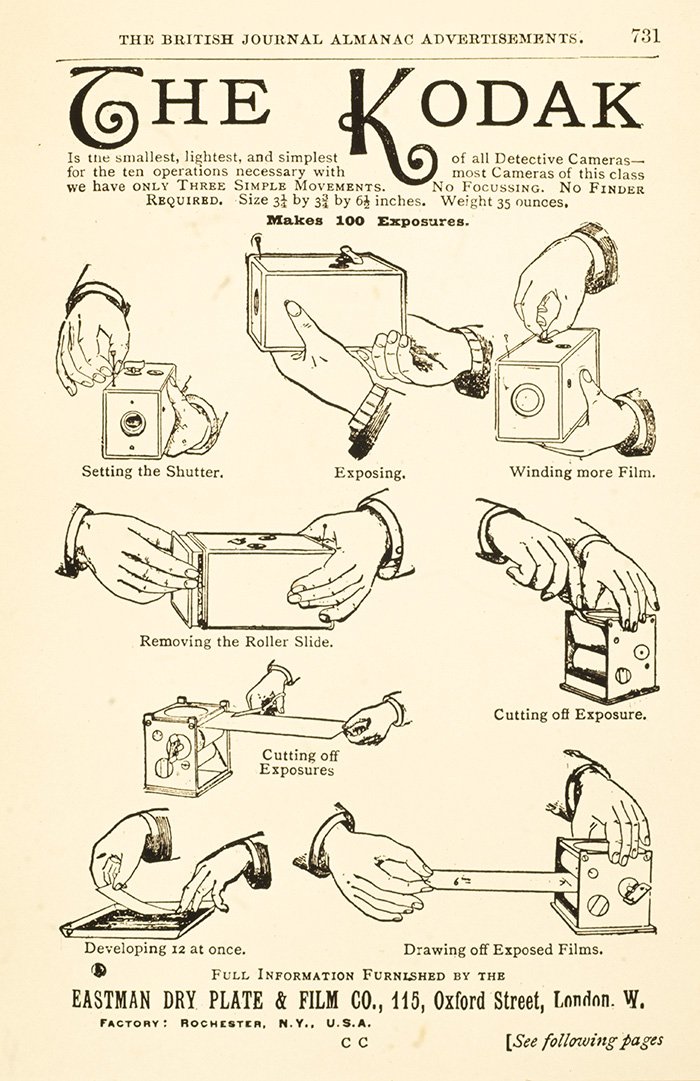
The process couldn’t be simpler, and all the communications emphasized that there were only three steps:
- Setting the shutter: This was done by pulling a string
- Exposing : Press the button on the side of the camera
- Winding more film : By turning the knob on top of the camera.
It is interesting to note that in the advertisement above, published in England, shows after the first three steps, an explanation of how to develop the film. Apparently, this is already celluloid film and not “American Film.” However, this was not strongly encouraged and was not part of the company’s strategy.

The most common pattern was the one shown above. First, the famous “You press the button, we do the rest.” Second, another statement that was also very common throughout all communications.
Anyone can take great photos with Kodak.
The camera was simple, but at the cost of being very limited in features compared to what would come soon after. It had no protection against double exposure or double film advance. There is no exposure counter. It offered only one shutter speed, around 1/25 s, and a single aperture setting of around f/9.
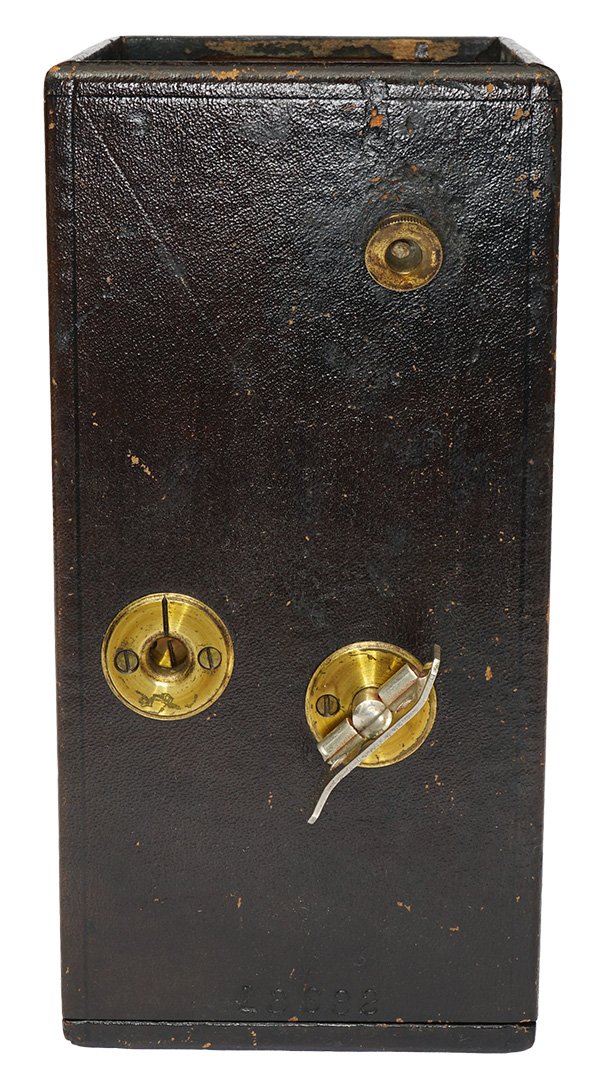
It doesn’t even have a viewfinder. At the top of the camera is a V-shaped mark, barely visible on the left side of the photo above. This was the guide for the photographer showing the photo’s boundaries. It corresponds to a 60° angle. The best strategy is to aim for centered compositions, which is also encouraged by the image’s circular format.
The shutter
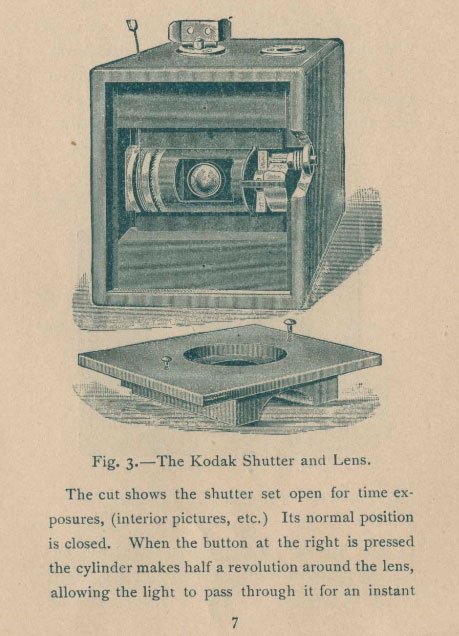
When it was first released, the Kodak No. 1 came with a rotary shutter, but it was expensive to produce and prone to malfunctions. As shown in the illustration above, it looked like a rotating cylinder. Few units were produced with this feature, and the company quietly replaced this key component of the camera within the first year. It didn’t even start a new serial number sequence; it simply continued with the existing one.
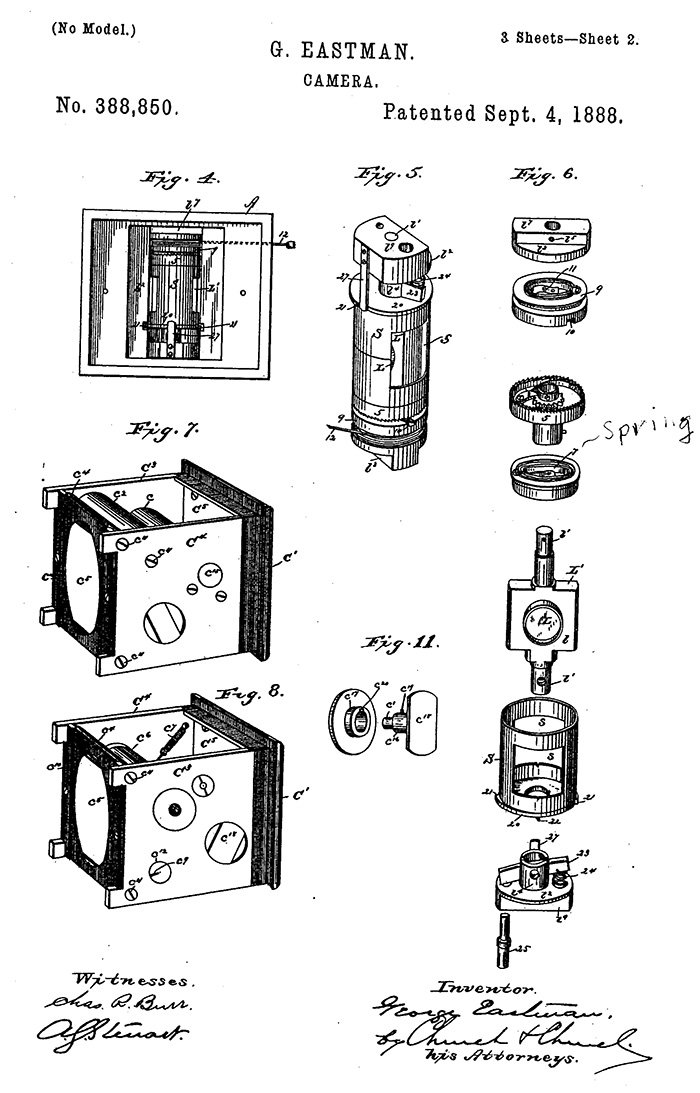
The camera in my collection has a shutter that is already of a second-generation model. To distinguish between them, in the literature the Kodak with the rotary shutter is referred to as the “original” or simply Kodak. At its launch, as we can see on the page from the 1888 catalog below, it wasn’t yet labeled No. 1.
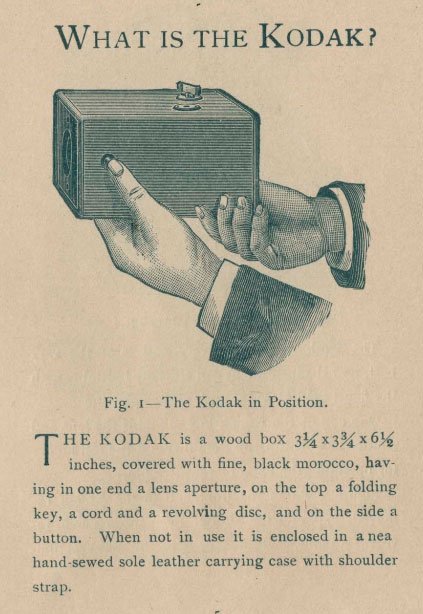
It was not until October 1889, when a new Kodak—designated No. 2, almost identical in every way to the original but producing a larger negative, 3 1/2″ in diameter—was introduced, that the original model was designated No. 1. It was at the same time that the Sector Shutter was introduced.
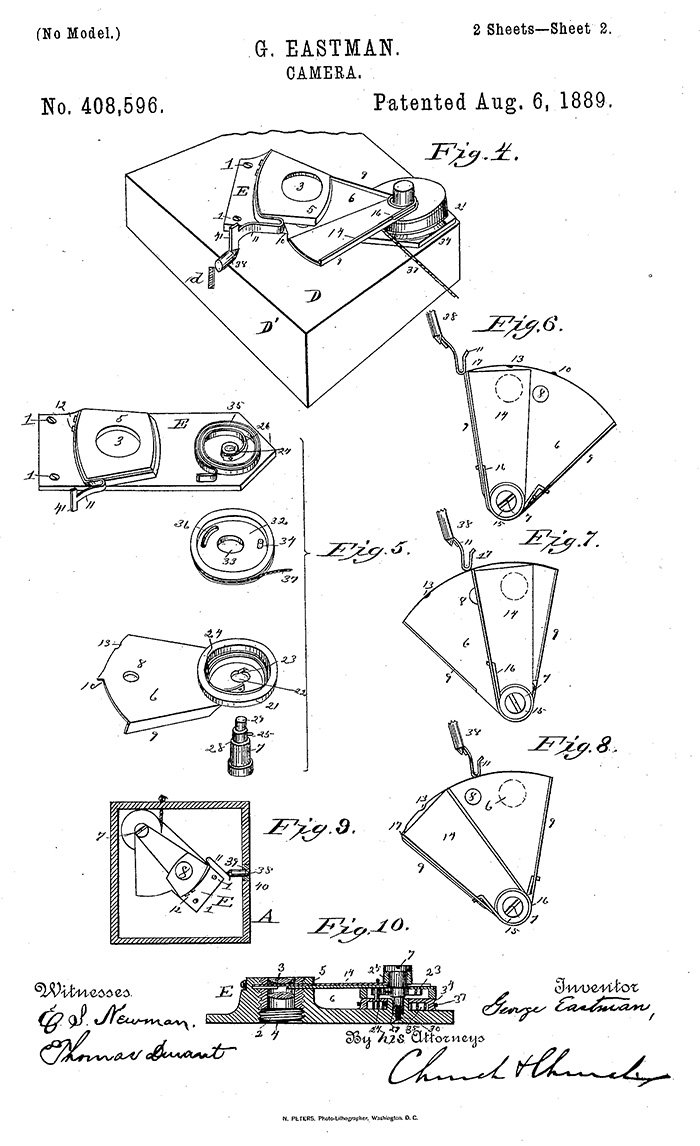
The basic concept of the Sector Shutter is shown above in the patent drawings. This type of shutter was used in popular Kodak cameras throughout the 20th century. It is basically a metal blade cut in the shape of a “sector” of a circle (like a slice of pizza) with a slit that passes in front of the lens, allowing exposure as it moves across it. A second sheet protects the lens as the sector returns to its initial position, preparing it for the next exposure. In the video below, we can see how it is cocked and fired in the Kodak No. 1.
Confusion About the Lens
The lens, manufactured by Bausch & Lomb, also based in Rochester, has a focal length of 57 mm and an aperture of f/9. There have been disagreements and controversies regarding its construction since its launch. A camera marketed with the slogan “You press the button, we do the rest” wouldn’t exactly be the type to go into great detail about its optics. As a result, there is no mention in advertising or catalogues about the construction type of the Kodak No. 1 lens. The manufacturer assumed that this was not of interest to its target audience.
This silence gave rise to speculation from those who were likely jumping to conclusions without even having the camera in hand. Articles in photography societies newsletters and bulletins or reviews in the specialized press were not unanimous in favor of one type of construction or another, and this created the confusion that persists to this day.
The Controversy
Fortunately, however, there was a case that received a lot of press coverage and finally clarified the type of lens used in the Kodak No. 1. Let’s take a look at what the controversy was about. Frederick T. Norris was a dedicated amateur photographer, writer, and technology critic who lived in London. He was very active in the British photography community and was also a purist, a defender of traditional photography, and believed that the new “detective” cameras were the ruin of photography.
It turns out that this influential Mr. Norris was spreading that the new Kodak No. 1 used a lens that was nothing more than a simple meniscus—not even achromatic—and cost the company just 6 pence. The camera sold for £5, which is 1,200 pence. One pence was the price of a pint of beer. So the statement was considered very offensive and a threat to the reputation of the camera and the Eastman Dry Plate & Film Co. itself.
This kicked off a series of letters that were published in The Amateur Photographer throughout 1890. The tone is reminiscent of what we see on social media today. But the subject matter is quite technical, and we can learn interesting points about photographic optics by following the debate.
William H. Walker stepped forward to defend Kodak. As a reminder, he was the one who, together with George Eastman, developed and patented the roll film back for view cameras. This was the same system that was later used in the Kodak No. 1. He had moved to England to establish Eastman Co.’s first branch office in 1887 and was the director of that London branch.
Norris was absolutely right in saying that the lens wasn’t achromatic, and it’s understandable that to ears less familiar with the issue, this must have sounded as if the camera price at 5.25 pounds was a fraud. As early as the 1840s—that is, 50 years before the dispute—it was already known how to construct achromatic lenses for photography.
Lenses that exhibit chromatic aberration—those that are not corrected—are difficult to focus. What happens is that the range of the spectrum to which the emulsions of that era were most sensitive is closer to the blue/violet band, but this is the band where our eyes see the least clearly; we see best in the middle of the spectrum, especially in the green range. Since a lens with chromatic aberration has a different focal point (the distance from the lens to the film) for different colors, when the photographer thought the image on the ground glass was very sharp, he was primarily influenced by the green. But the film or plate, which could only see blue and violet, recorded an out-of-focus image because these focal points did not coincide as they would only with a corrected lens. This is what is known as the chemical focus problem.
Marketing a non-achromatic lens in 1890 seemed like a step backward, a deception. But there’s a good explanation for this. What photographers did in the era of uncorrected lenses was to focus using the green-side correction, but then manually adjust to the correct position using the blue side, relying on a chart or formula to do so. When corrected lenses appeared, this was no longer necessary. It turns out that the Kodak No. 1 had no focus adjustment. So it was already designed for chemical focus: it wasn’t corrected, but it didn’t require any adjustment by the photographer. At f/8, it provided a depth of field that offered reasonable focus—for a contact print—from 4 feet (1.2 m) onwards, according to the manufacturer.
As for the type of construction and its supposed low cost, Mr. Norris was wrong. The lens was not a simple meniscus. I quote here the words of William H. Walker, addressing Norris:
“To show you just how misleading the statement attributed to you is, we will state that all the lenses supplied with the No. 1 Kodaks are, and have always consisted of, two periscopic lenses with unusually deep curves, a fact that in itself would increase their cost immensely.” (July 18, 1890, The Amateur Photographer)
A periscope lens consists of two meniscus lenses arranged symmetrically around the aperture, which, in the case of the Kodak No. 1, has no iris and it is fixed at f/9, as previously mentioned. Regarding its origin, in the same issue of The Amateur Photographer dated July 18, 1890, John Traill Taylor—the legendary editor of The British Journal of Photography, who published books on photographic optics—explains its genealogy.
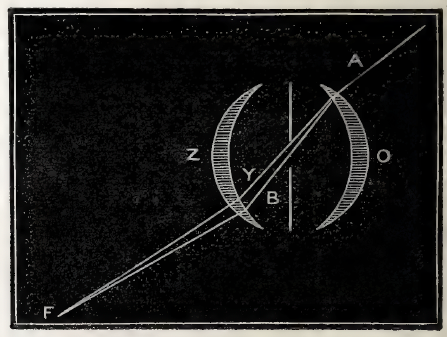
“Regarding the lens of your No. 1 or small Kodak, do you know its history? If not, I will tell you about it. Several years ago (1865), Prof. Steinheil of Munich invented and patented it. It was manufactured by Voigtlander and sold under the name “periscop,” derived from the periscopic shape of its two lenses. It was rectilinear and covered a prodigious field of view that was sharp right to the edge. […] Upon examining a small No. 1 Kodak lens—which was once in my possession—that I realize it is a revival of Steinheil’s once-famous Periscop, although, thanks to recent improvements in the manufacture of optical glass, it surpasses its predecessor in speed of operation, without losing, as far as I can tell, any of its other fine qualities.”
This should have put an end to the theory that the lens of the first Kodak was a simple meniscus. But the confusion persists, because decades later, Kodak released other models labeled “No. 1”—such as the No. 1 Pocket Kodak or the No. 1 Autographic Kodak Junior—which bear no relation whatsoever to the brand’s inaugural camera but did, in fact, use a simple meniscus lens.
Rapid Rectilinear
Another source of confusion—which, rather than downgrading the Kodak No. 1 lens, results in an incorrect upgrade—stems from the fact that, shortly after its introduction in late 1888, other models were released based on the same box camera or bellows design, but this time—likely due to the larger formats—they featured a more elaborate lens design.
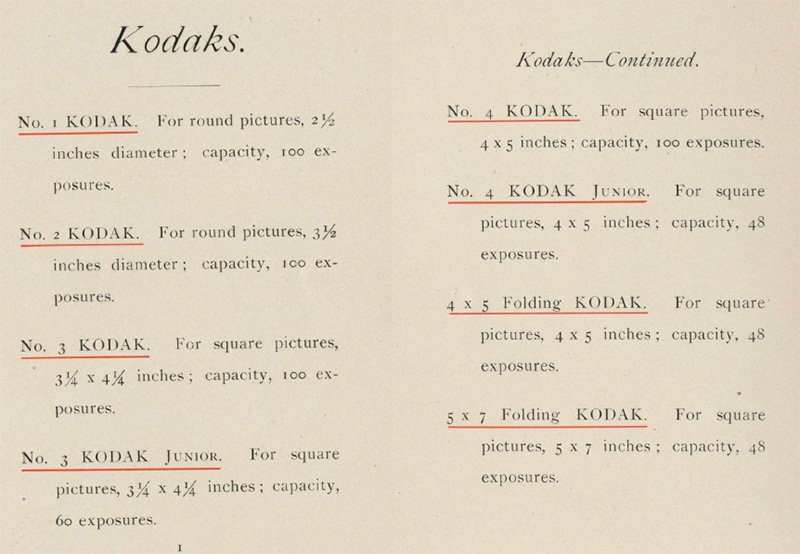
Above are two pages from the catalog featuring Kodak cameras, showing the formats and capacities already on the market in 1889. We can see that the product line grew rapidly, and it’s worth noting that by January 1890, the new transparent celluloid-based film was already in full distribution and quickly replaced the cumbersome American Stripping Film.
Drawing once again on the statements of a brand representative—this time Mr. H. M. Smith, who was a renowned traveling lecturer and technical demonstrator hired by the Eastman Company—I reproduce below an excerpt published in The British Journal of Photography —July 25, 1890—recounting what took place at one of these meetings, this time at the Newcastle-on-Tyne and Northern Counties Photographic Association:
“He [Mr. H.M. Smith] wished to state, as publicly as possible, that in the Kodak No. 1, the lens was not a single lens but a periscopic—a doublet lens. It was not achromatic, but was positioned to operate at its chemical focus, and he could cite results to demonstrate its quality. With the sole exception of the No. 1, all other models of Kodak cameras distributed by his company were equipped with rapid rectilinear lenses manufactured by one of the leading lens manufacturers in America [Bausch & Lomb], and they would stand up to comparison with any on the market.”
Since their introduction in 1866—simultaneously and independently by Dallmeyer and Steinheil (under the name Aplanat)—the Rapid Rectilinear lenses were the best available for general-purpose use. They were only surpassed by the introduction of anastigmatic lenses in the early 1890s. With an aperture of around f/8 and an angle of view of around 50°, they played an important role in making it possible to build cameras with fixed lenses.
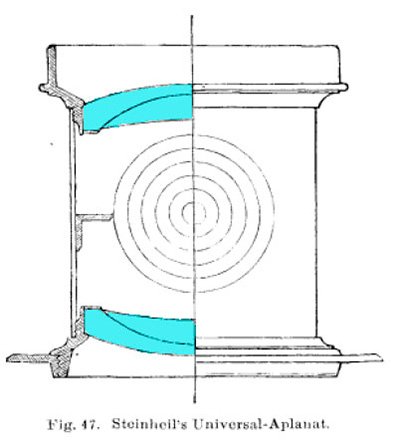
However, it looked very similar to the periscope, since from the outside, all that one could see were two symmetrical menisci. The difference was that these menisci were formed by two pieces of glass cemented together—and this time, they were indeed achromatic.
The Empirical Candle Test
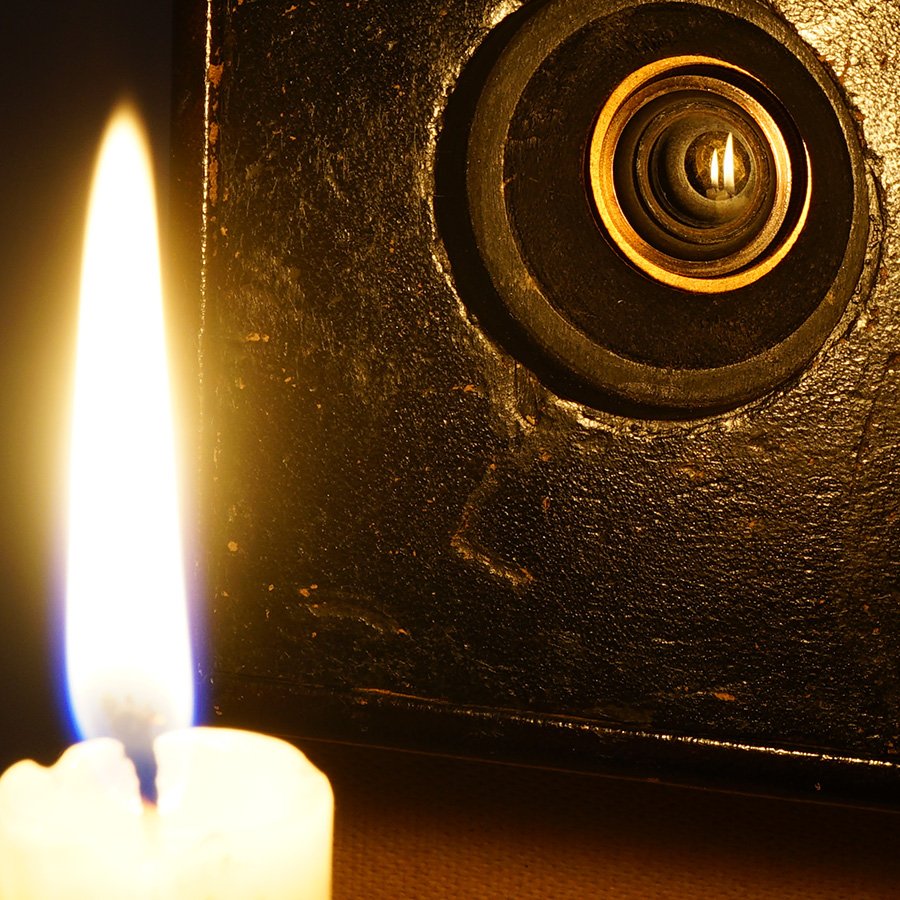
It’s not easy to “count” how many elements an optical group has when it’s cemented together. But one method that works when dealing with just a doublet (two lenses) is to place a light source in front of it and observe how the light reflects off the surfaces.
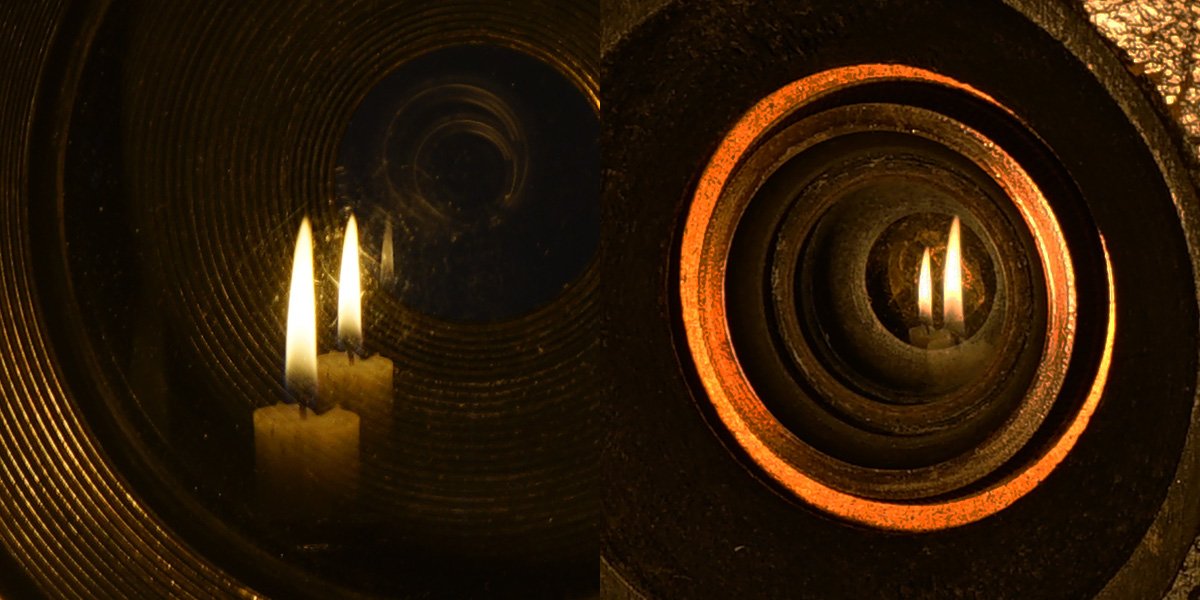
On the left is the front element of a genuine Dallmeyer Rapid Rectilinear; we see two very bright reflections of the candle produced by the first air-to-glass and then glass-to-air interfaces. The third, very faint reflection that we see further in the background is the reflection at the glass-to-glass interface, where the doublet is bonded. On the right is the periscope lens from the Kodak No. 1. In this case, we see only two reflections, indicating that there is only a single glass element as the front element.
Since few people would have performed—or even known how to perform—this inspection, and since all the other Kodaks did in fact have a Rapid Rectilinear lens (as Mr. H.M. Smith stated), it was very easy for all of them to be assumed to be Rapid Rectilinears.
Another factor to consider is that the terms “Rapid” and “Rectilinear” may simply be adjectives and not a reference to a specific Dallmeyer/Steinheil lens design. Because of its symmetry, the Periscop is in fact a distortion-free lens (it renders straight lines as straight); in that sense, it can be called “rectilinear.” With its f/9 aperture, it can be considered—with a little goodwill—a fast lens for its time. Thus, manufacturers could use these names to describe (genuine) qualities, and photographers could interpret them as referring to the 2+2 construction—that is, two groups of two optical elements.
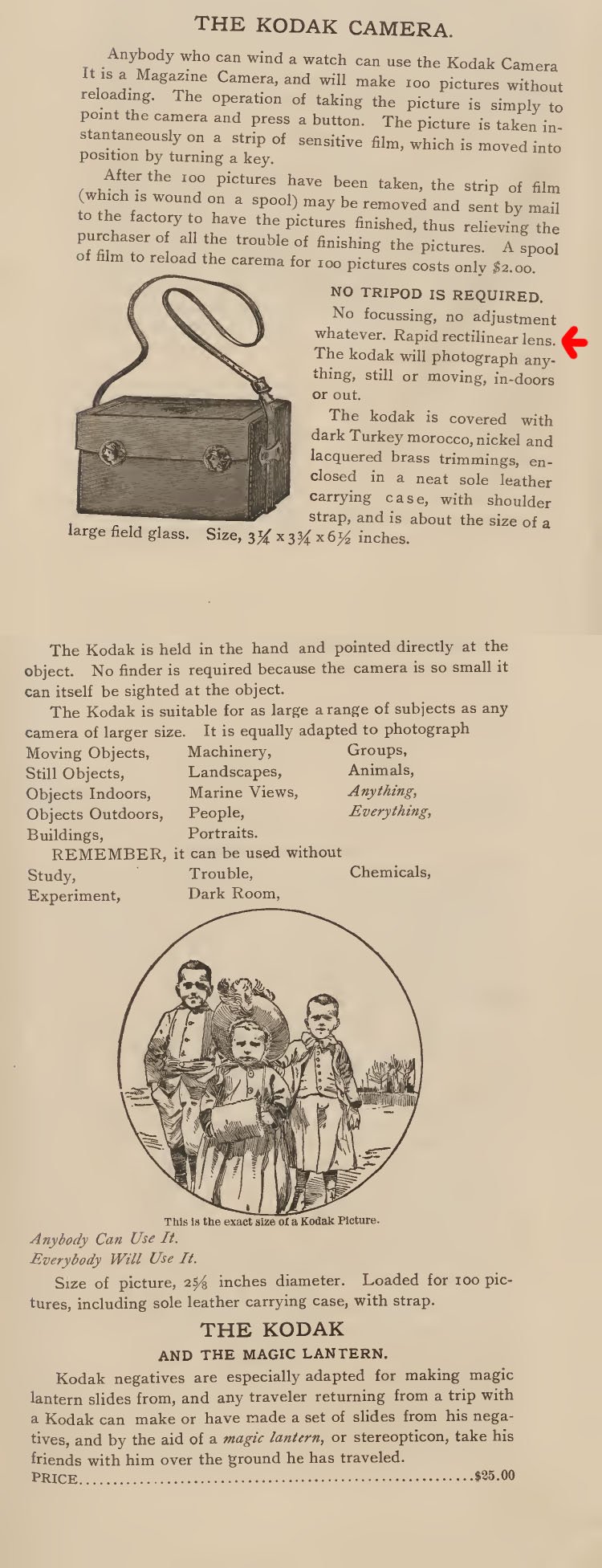
It’s very common to come across articles and camera reviews that make this mistake. As in the example above, a Magic Lantern manual advises using Kodak film to make slides.
Production and Serial Numbers
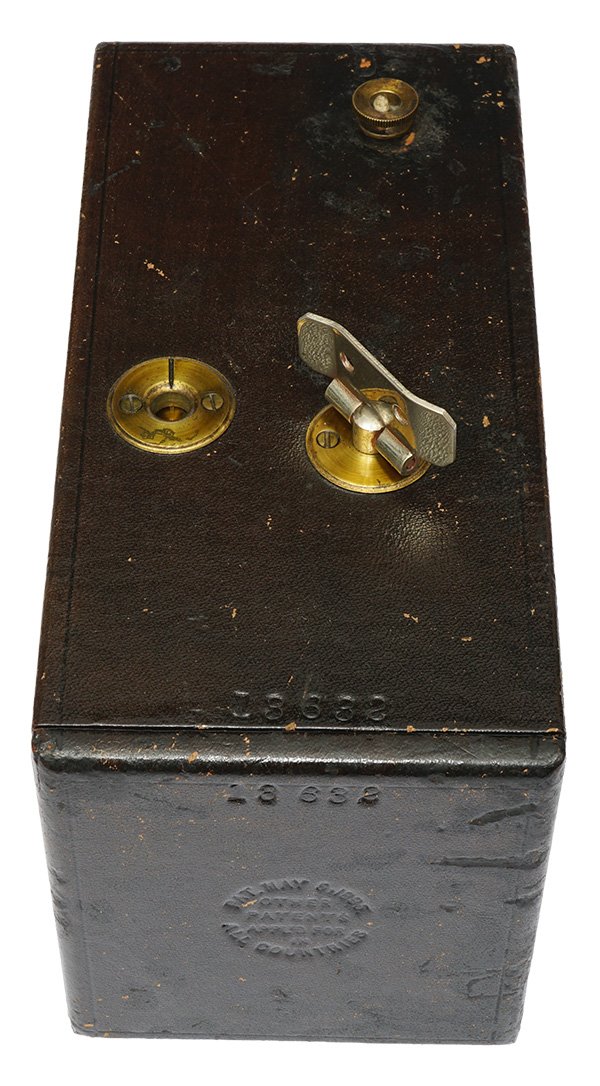
In Brian Coe’s book Kodak Cameras, The First Hundred Years, he notes that more than 10,000 units of this camera were produced between 1889 and 1895 when it was discontinued. Considering that as early as 1889, variations No. 2, 3, and 4—mentioned above—appeared, along with two folding models, this is a considerable number.
This one from the collection is number 13,632. It is interesting to note that, since the entire camera was sent to Rochester or another location where Eastman Kodak offered photo-finishing services, the number is stamped on the body and also on the back of the camera to assure the photographer that none of the parts had been swapped out.
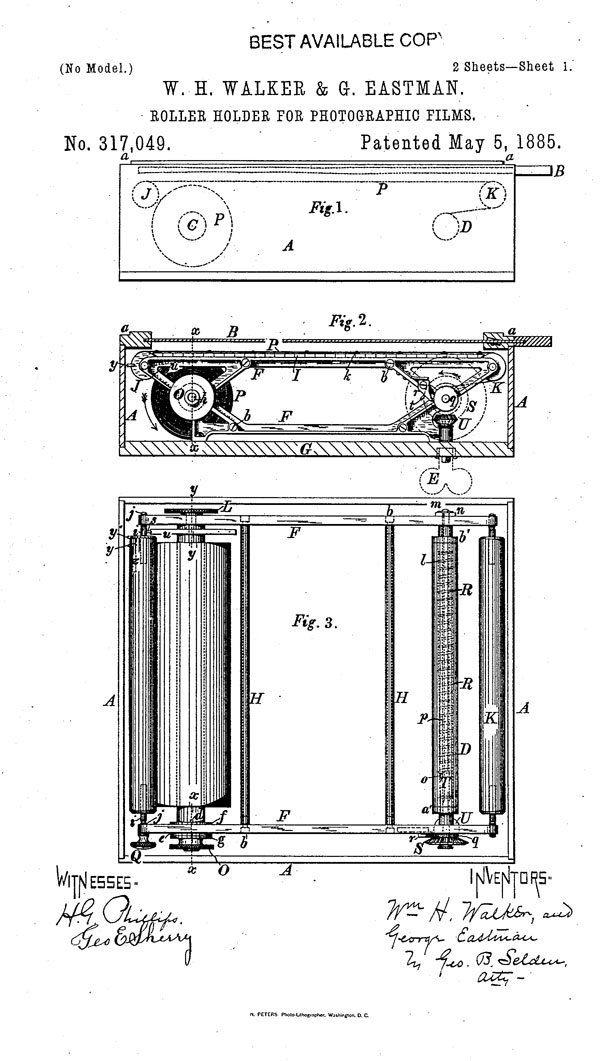
The round stamp on the back of the camera refers to the May 5, 1885, patent for the film transport system. It reads:
PAT MAY 5, 1885 OTHER PATENTS FILED IN ALL COUNTRIES
Below is the first page of the patent issued to W.H. Walker and G. Eastman; in this case, it was for the Roller Holder adaptable to view cameras, but the technology was later used in the Kodak No. 1 as well.
In use
What interests me most about photography is studying its relationship with society and how the production and circulation of images take place in our culture, particularly in terms of how it relates to our values and behaviors. But another very interesting aspect of collecting such old cameras is that it’s still possible to use them, albeit with some modifications in certain cases.
Recreating the American Stripping Film would be an insane project; it would likely require an excessive number of hours and it would be most likely a failure. The difficult part would probably be achieving the flexibility, thickness, and other mechanical properties compatible with the camera’s transport system. Making the emulsion and applying it to the soluble gelatin—though complicated in itself—might actually be the easiest part.
But the simple solution of cutting a piece of modern film and placing it in the camera’s focal plane is extremely easy and convenient. The round mask works perfectly to keep the film in place.
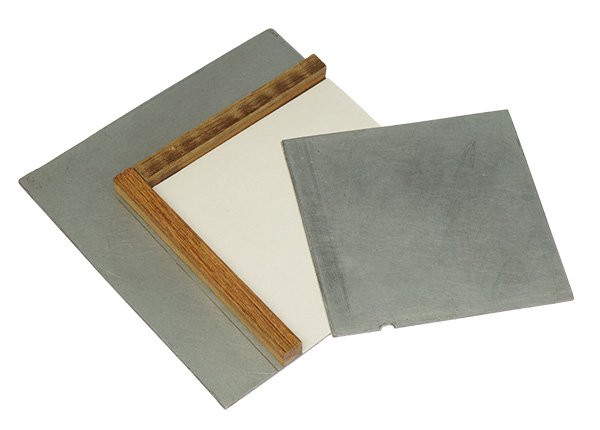
With this metal homemade accessory, it’s very easy to cut a 9×12 cm or 4×5″ film to the exact size that fits in the Kodak No. 1, even in the complete darkness of the darkroom.
With this setup I can’t take 100 film photos without reloading the camera, as it was the original idea with the Kodak No. 1 and American Film. But it’s still a different and interesting challenge—quite the opposite, actually—going out knowing that I have only one sheet of film and that if I mess up, there won’t be another chance.