Désiré Lebrun | Sliding box camera
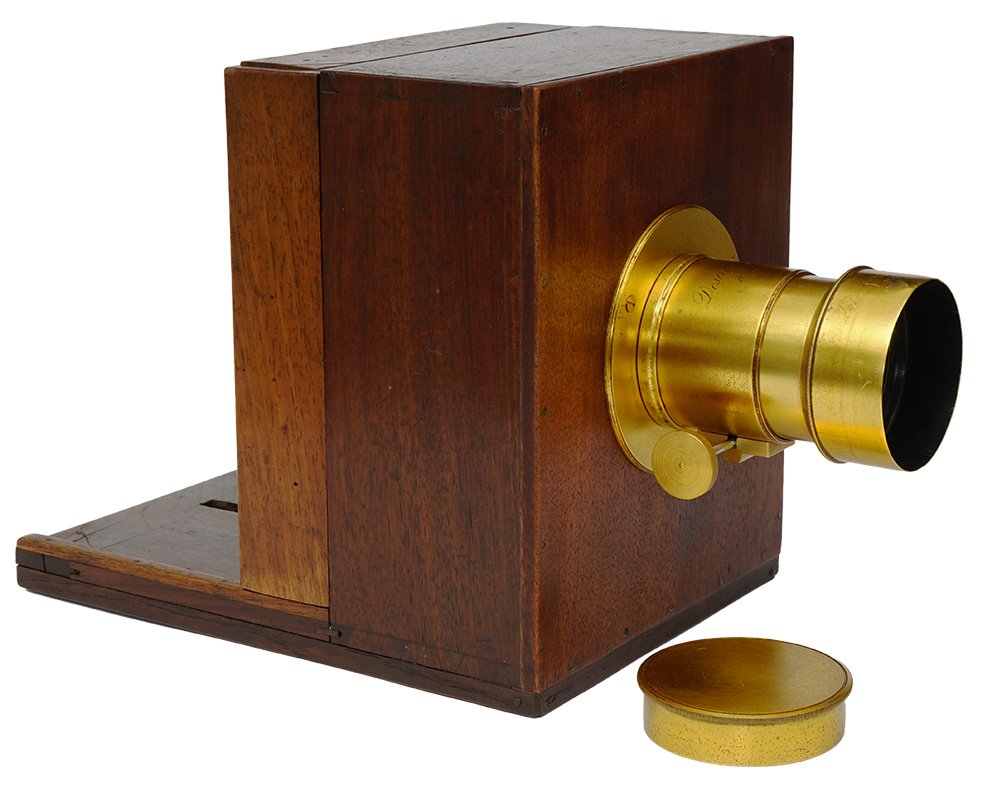
This camera, built between 1851 and 1853 in Paris by Désiré Lebrun, is modeled after the first commercially available cameras for photography. What most clearly identifies it as truly first-generation is the absence of a bellows, as it belongs to the category of Chambre à tiroir, which loosely translates to “drawer camera”. In English, this category is known as a “sliding box.”
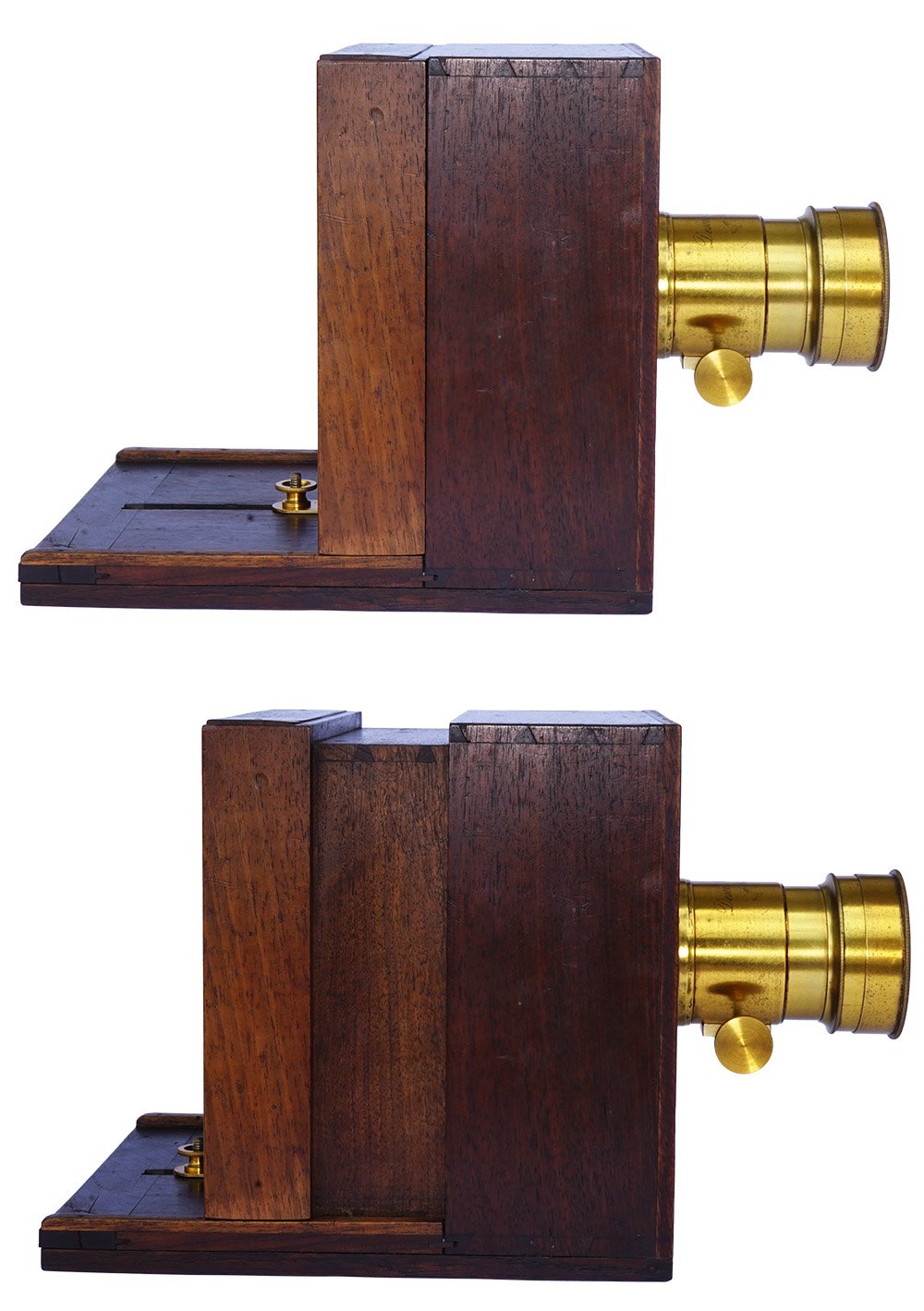
It’s a very simple concept that uses one sliding box inside another to vary the distance between the lens and the plate, thereby achieving focus, without allowing light to enter the camera. After locking the position of the “sliding box” using a screw at the base of the camera, you can also make fine adjustments using the rack on the lens. If you’re not sure how lenses focus images, visit the page: focal length.
It is interesting to note that although they are very simple in construction—and even have an advantage over bellows, which tend to deteriorate over time— sliding box cameras have a drawback. The fact is that when you want a camera that allows you to change lenses—from one with a wider angle to one with a narrower angle, as is typically the case when switching from a landscape lens to a portrait lens—you need to vary the distance from the lens to the plate or film significantly. The bellows allow for this. Between the shortest and longest distances, with the bellows fully extended, we can easily achieve a 4x extension factor; however, due to the rigid architecture of the box itself—in the case of the sliding box camera—not even a 2x magnification factor is possible, since the box containing the plate or film will extend beyond the lens housing.
For this simple and limiting reason, this type of camera tends to be specialized and, as is the case with this one from the collection, often comes with a fixed lens because the body is designed specifically for it. There isn’t even a lens board to allow for lens changes.
This camera was designed to take photographs in the 9 x 12 cm format, also known as 1/4 plate. It is, therefore, a small camera designed specifically for portraits, to the extent that it is not possible to rotate the frame for a horizontal shot, which we usually call a “landscape.”
The camera itself has no inscriptions or markings. It was very common back then for a manufacturer to order a generic camera from a woodworking shop; it was sold together with the lens, and only the lens bore the optician’s name.
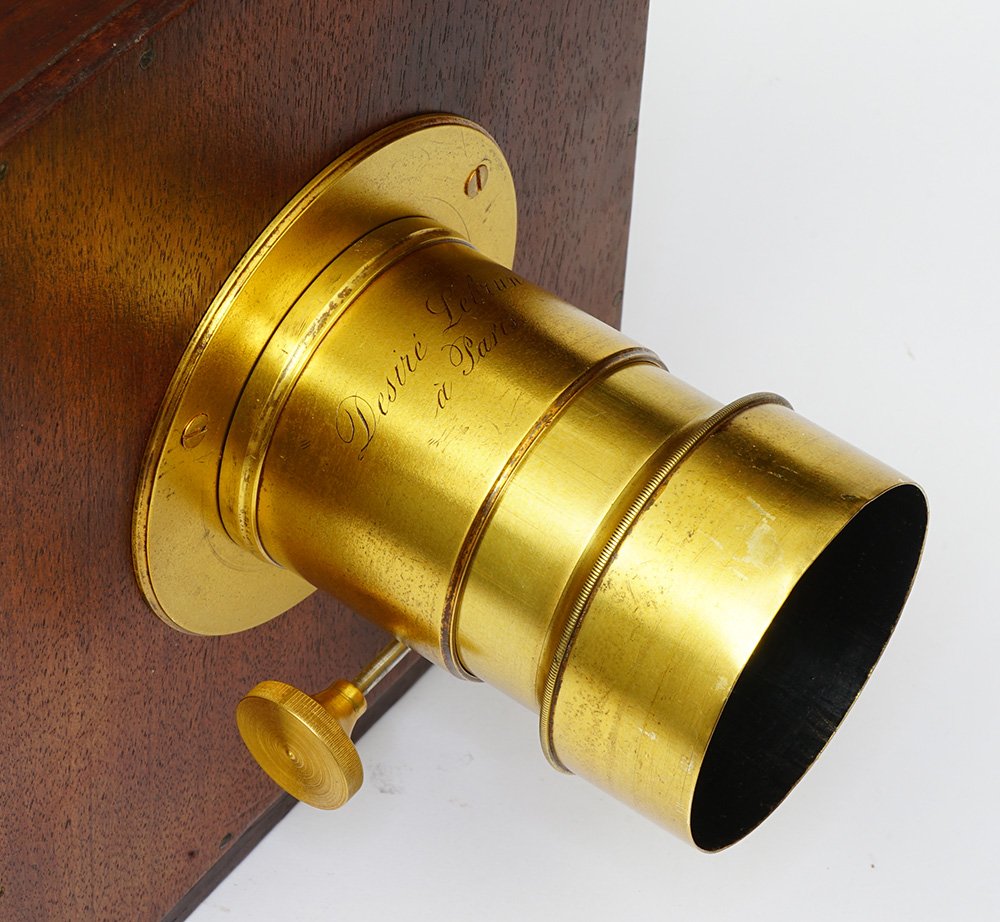
According to Pont & Princelle (No. 24), Lebrun was active from 1847 to 1865. He was a manufacturer of precision instruments, and with the advent of photography, he began to design and manufacture lenses as well. He was an active member of the Société Française de Photographie (SFP) and, in particular, collaborated with the glassware manufacturer Louis-Joseph Maës (1815–1898), based in Clichy on the outskirts of Paris, to develop enormous lenses.
The journal La Lumière contains an article dated April 7, 1855, that describes experiments conducted by the famous photographer André Adolphe-Eugène Disdéri during a SPF’s event. He took four portraits using a lens made in partnership between Lebrun and Maës. Everyone present was impressed by the quality of the image, which was 2/3 life-size in a close-up portrait. What’s incredible is that this lens had a diameter of 10 pouces, which is today 27 cm, almost 11 inches! It was about the size of a dinner plate. It was a “verres combinés” type of lens, that is, a Petzval for portraits (the French did not use the name of the Austrian inventor, Joseph Petzval). The article states that the aperture was 10 cm and the subject was 3 meters away. This suggests a focal length of 800 to 1,000 mm.
Parisian opticians manufactured these giant lenses, using 11-inch glass plates, not for regular sale to commercial photographers or artists, but to demonstrate that French glass manufacturers (such as Saint-Gobain, Maës, or Guinand’s successors in the optical glass sector) were capable of molding perfect, bubble-free flint glass discs up to 27 cm in diameter, free of optical stress. What Lebrun and Maës were presenting on April 7, 1855, was likely a preview of the upcoming 1855 Paris World’s Fair. In the midst of the Industrial Revolution, these expositions served as the grand arena where the world’s major powers measured their technological capabilities against one another.
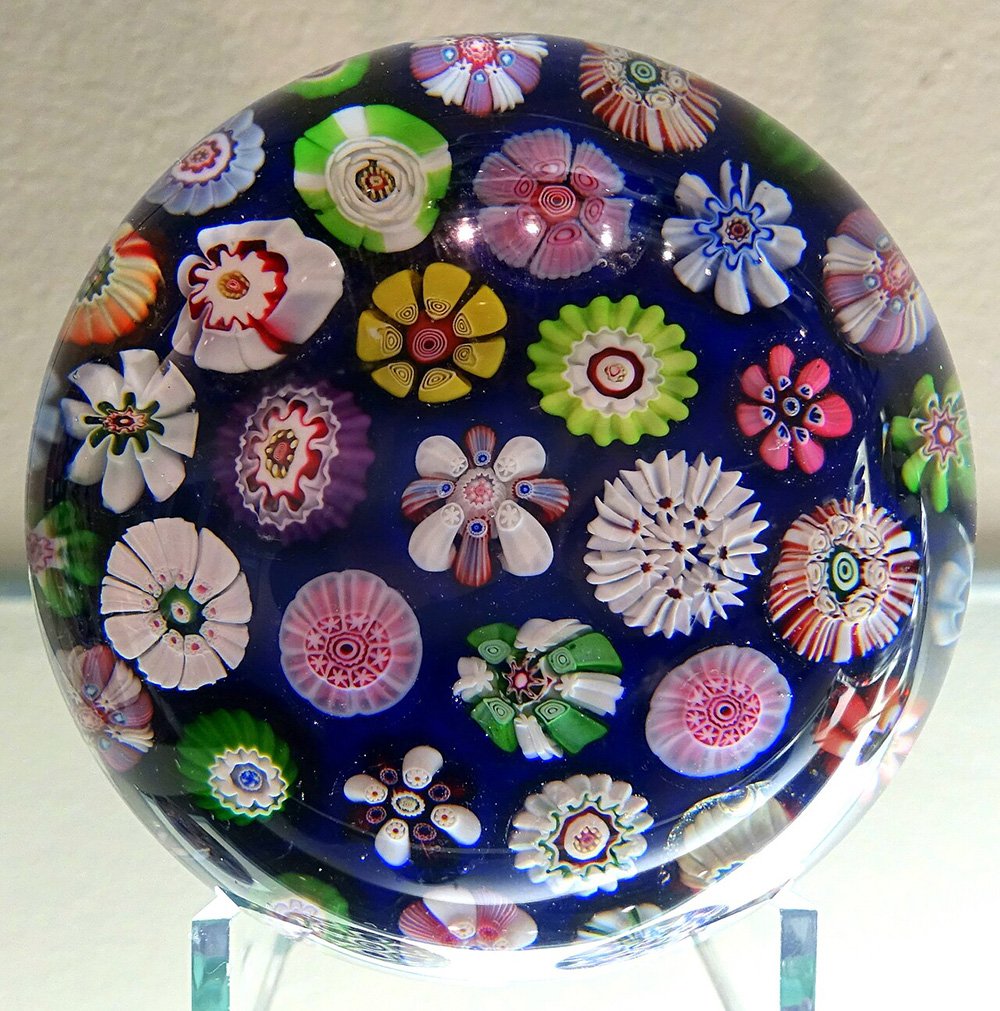
Below is a totally different glass piece crafted by Louis-Joseph Maës in the 1850s. It’s interesting to note how research into glass at that time served both to accelerate the boom in the photographic optics industry and to produce handcrafted pieces with an impressive level of detail, as is the case with this paperweight.
A camera for wet plates
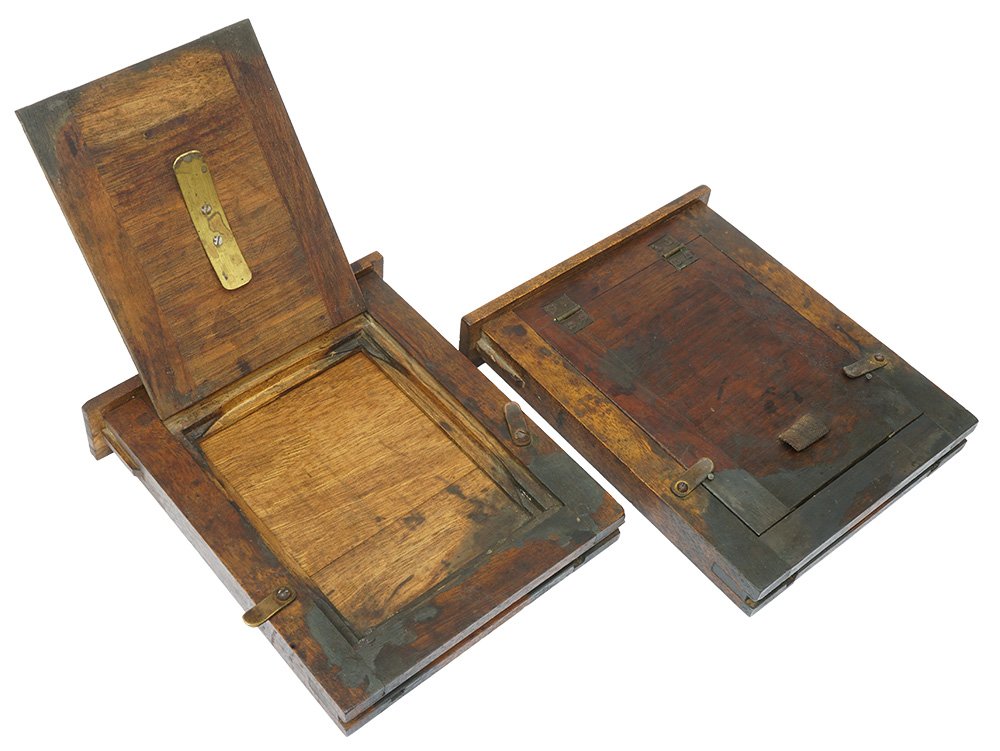
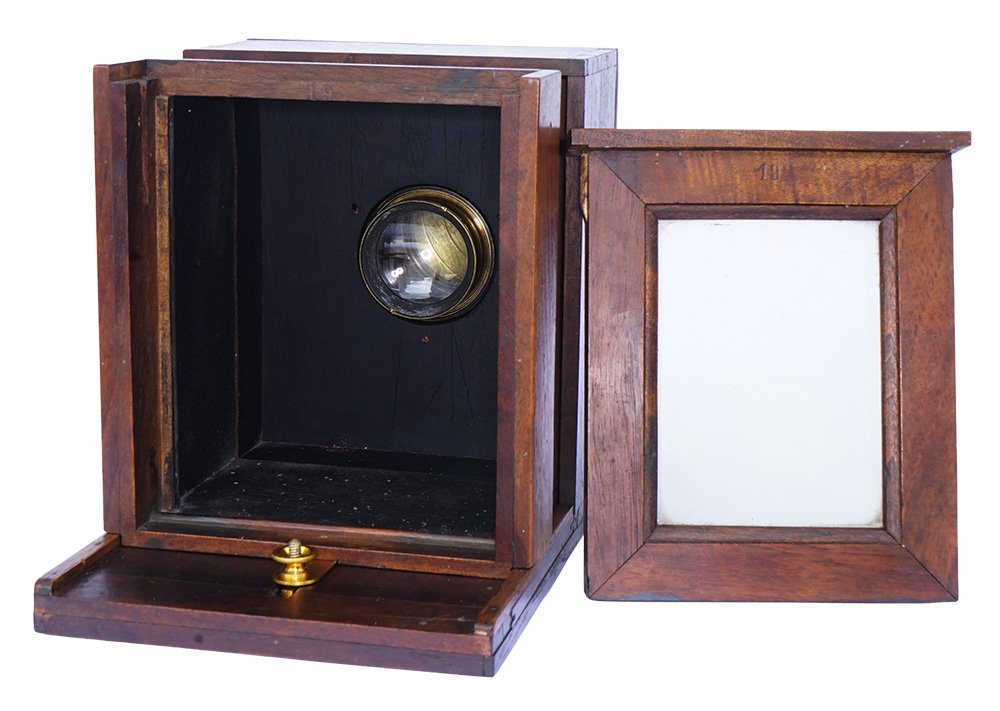
This camera came with two original plate holders typical of collodion or wet-plate cameras, a process introduced in 1851 that would go on to dominate photography almost entirely for three decades. These are single-plate frames that are loaded from the back—as shown in the photo above. You can also notice the stains, mostly on the lower part of the holders. These are stains from the silver nitrate solution used to coat the collodion-covered glass at the very last moment before the photograph was taken.
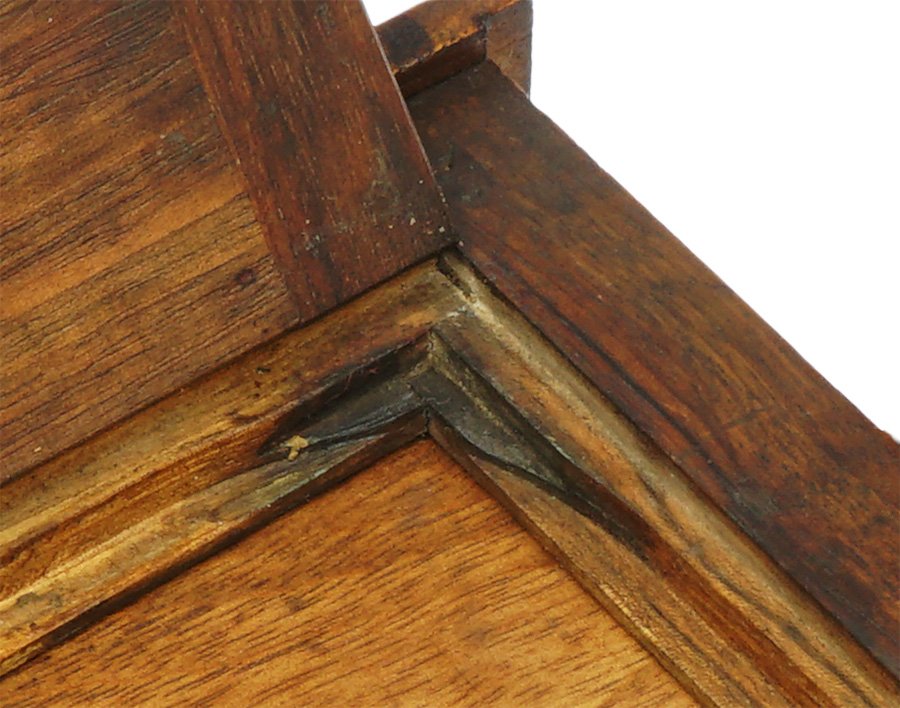
Another unmistakable feature of wet-plate plate holders is these corners that raise the plate so it does not touch the chassis along the entire frame. This was a solution to minimize contamination—both of the holder by the plate’s emulsion and of the plate by the holder. In the early 1850s, these were small pieces of wood glued to the corners (as shown in the photo above); later, they were carved directly into the chassis frame itself; and finally, they were inlaid with more durable materials such as ivory, gutta-percha, or silver wires. This progression in form and materials used allows us to date this camera with a high degree of certainty to between 1851 and 1853.
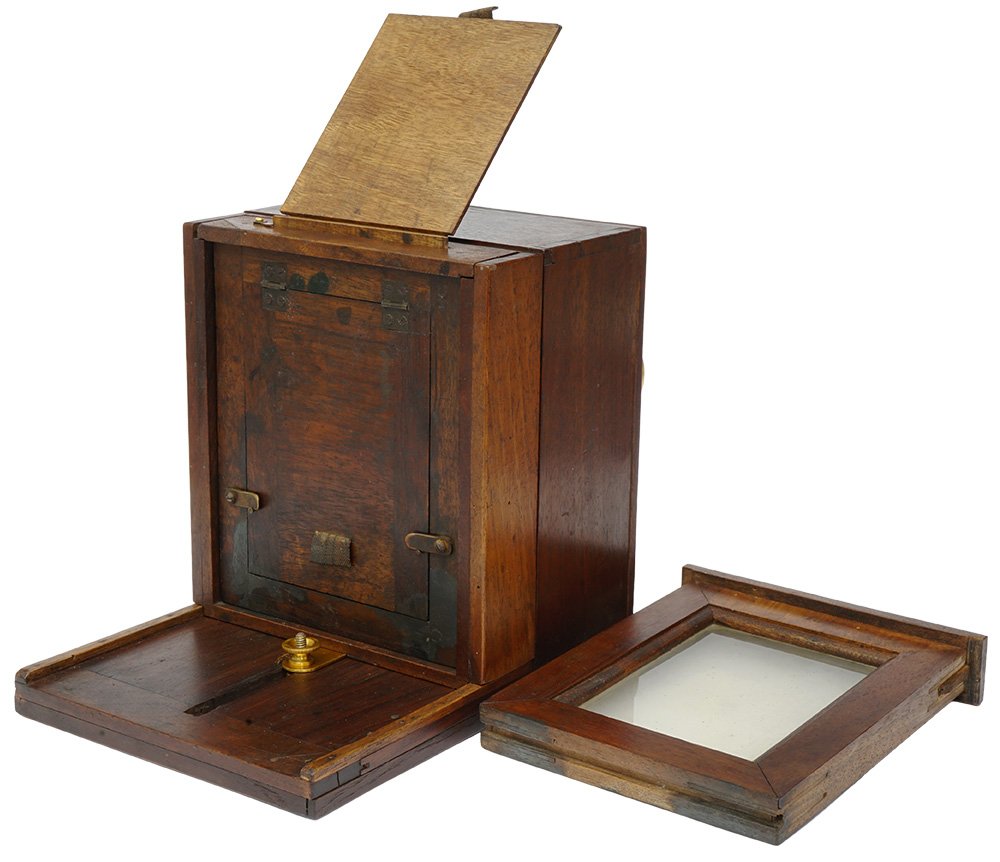
It’s very simple to use. Just frame and focus on the ground glass using a black cloth and, if necessary, a magnifying glass. Next, remove the screen, insert the film holder, and pull the dark slide to expose the plate or film, as shown in the photo above.
The lens cap was simply used as a shutter, and it is also interesting to note that lenses from that era had neither an iris nor insertable diaphragms—known as Waterhouse stops—because the sensitivity of the photographic materials was so low that the lens was invariably used at its maximum aperture.