year
Chronological circuit, after 1965
1966
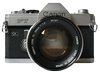
Canon, Canon FT QL
This camera marked the beginning of the consolidation of Canon’s reputation in the competitive SLR market.
1967

Olympus, Olympus Trip 35
A best seller in the 1970s, this camera, like its predecessor the Olympus Pen, combined ease of use by offering automatic exposure with even higher image quality in the full 24×36 mm format.
–
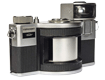
KMZ, Horizont
Panoramic for 35mm film that makes 24 x 58 mm negatives. It covers 120º and uses the rotating lens system.
–
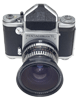
Pentacon Six TL
Far from the original Rolleiflexes or Hasselblads, the 1960s saw the consolidation of a category of medium format cameras that looked like enlarged 35mm cameras, offering 6×6 or larger negatives on 120 film.
–
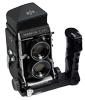
Mamiya, Mamiya C330
Since 1940, Mamiya has been making medium format cameras with a reputation for robustness and quality. The C330 was part of a unique system among all TLRs, with interchangeable lenses and various accessories.
–

Praktica- VEB Pentacon Praktica
The Praktica name came from 1949 as a robust SLR for the amateur market. In 1970 it introduced the metal curtain, through-the-lens photometry and the design that was to remain until the end. It was a huge success worldwide and shared the title of “student’s camera” with the Pentax K1000.
–
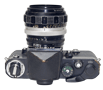
Nippon Kogaku, Nikon F2
A completely revised and much improved edition of the then already famous Nikon F. This camera further consolidated Nikon as a kind of official equipment in photojournalism.
–
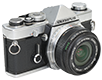
Olympus, Olympus OM
The OM represented a shake-up in the SLR market. With the same basic specifications as a Nikon F2 or Canon F1, it is much smaller, lighter, quieter, has a range of excellent quality optics and time has proven its robustness as many still work today.
–

Olympus, Olympus 35DC
Olympus has done a lot of experimenting in the field of viewfinder cameras. The 35DC has a rangefinder, full exposure automatism, a CdS light meter and a high-performance lens.
1975
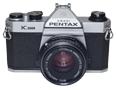
Pentax, Pentax K1000
Similar to the Spotmatic of 1964 but with a bayonet mount, the K standard. Fully manual, very robust and affordable, this camera became something of a student photographer’s camera and remained in production until 1997.
1977

Nikon, Nikon FM
Losing sales to cameras with similar specifications but smaller and simpler construction, Nikon reacted by launching its FM. Fully mechanical, without the modularity of the F2, but at a more affordable price. A typical example of less is more, because it’s an excellent camera.
1982
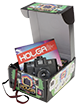
Tsun Ming, Holga 120CFN
All plastic, including the lens, it was a cheap camera aimed at the mass market of Chinese workers, but ended up becoming fashionable among Western hipsters.
1986

Kodak and Fuji, disposable cameras
Plastic cameras, “dressed” in a paper cover, already loaded with film, equipped with a flash and for one-time use.