year
Chronological circuit, 1916 to 1930
1916

Hugo Meyer, Trioplan
Derived from the Cooke Triplet, this lens was launched as a more affordable option due to its simple construction and therefore lower cost, but today it has become a cult with a huge price upgrade due to its bokeh, which is considered wonderful.
1917

Ernemann, Film K
Wood and leather camera box. Lens is a simple meniscus with f/12 aperture. In 6×6 and 6×9 formats for 120 film.
1920

Voigtlander, Bergheil
Excellent build quality and usually comes with the wonderful Heliar lens. In the 6.5×9 cm format, it’s a harmonious camera in its dimensions and very versatile in use.
–
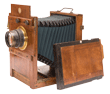
Alfred Bruckner
View camera in 13×18 cm format with simplified design in portrait format.
–
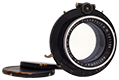
Plaubel, Anticomar
A lens that later became famous on the Plaubel Makina medium format camera. But it already existed for large format, like this 300mm f/4.2 that does 8×10″.
1921

Kamera-Werkstätten Guthe & ThorschBruckner, Patent-Etui
Incredibly compact when closed, this 6.5x9cm is a very cleverly constructed and elegant camera. Fun fact: KW is the same company that would later launch the famous Praktica SLR.
1922

Hugo Meyer, Plasmat series
Paul Rudolph, the genius of Carl Zeiss, was in retirement, but had to return to work after the war. He created the Plasmats for Hugo Meyer, a concept that would later be continued by many other designers on many famous lenses.
–
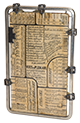
Kaufmann, Posographe
This mechanical pocket calculator uses sliders to set the time of day, time of year and ambient conditions and provides the speed and aperture to be used on the camera.
1925
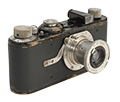
Ernst Leitz, Leica A
Amicroscope manufacturer ventured into the camera market with an idea unlike anything else, a camera using film. It was a huge success and changed the history of photography.
explore
–

Ernst Leitz, enlargers
When launching the revolutionary Leica A, Leitz also had to offer everything photographers would need to handle, process and enlarge the small 24×36 mm negatives that the camera made with film. Reels, developing tanks and enlargers formed the basic kit in addition to the camera. The enlarger in the collection, a Leitz IC, is much more recent, having been manufactured since 1951.
–

Hermagis, Dellor
Little-known lens. Probably from the last years of the very old Hermagis. It’s a large format double-gauss.
–

Voigtlander, Universal Heliar
Adjustable soft-focus version of the famous Heliar. By turning a ring, an internal element of the lens is displaced, thus introducing a variable amount of spherical aberration which gives the diffuse effect in the image.
1926

Zeiss Ikon, Box Tengor
A box camera with excellent construction and finish. It uses 120 film and takes photos in 6x9cm format. A very good size for contact prints for the family album.
–

Kodak, Rainbow Hawk-Eye Vest Pocket
The name already evokes that this was a derivative series in various colors. A 127 film folder with 3 aperture options and 3 speeds in addition to B and T.
explore
1930

Ernst Leitz, Leica Ic
Leica standardizes the lens mount and thus begins the development of a line of very high quality lenses as a way of compensating for the small size of the 24x36mm negative.
–
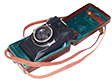
Zeiss Ikon, Kolibri
Very nice camera for 127 film. Compur shutter, good optics available and a luxurious case with yellow filter and close-up lens.
explore
–

Kodak, Beau Brownie
Reinventing the old Brownie #2, now with an art-deco look and offered in several colors. It uses 120 film and takes 6x9cm photos. Great for outings on clear days.