year
Chronological circuit, 1946 to 1955
1946
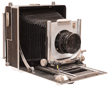
Linhof, Technika 13×18 cm
The Linhof Technika, as an all-metal drop bed camera manufactured with extreme precision and flexibility of controls, has been around since the beginning of the century. But if we consider the adoption of the universal chassis as the start of a new era, then 1946 is the date of its birth, or rather rebirth.
–

Linhof, Technika 9×12 cm or 4×5″
This was the format that became a kind of standard for professional still photography. The Linhof Technika took pride of place due to its somewhat hybrid nature, as it lends itself to both outdoor and studio photography.
–

Linhof, Technika 6.5×9 cm or 2¼ x 3¼ “
With this camera, Linhof seemed to think it would solve all the problems photographers face in all situations. It’s wonderful, but the concept lost its meaning at a time when cameras and photographers tended strongly towards specialization.
1947
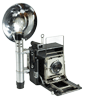
Graflex, Crown Graphic 4×5″ Pacemaker
An icon of American journalistic photography in the 1950s, the Crown Graphic simplified the Speed Graphic by dispensing with the focal plane shutter. Much lighter than a Linhof Technika, it allowed street photography at 4×5″.
explore
–

Graflex, Miniature Pacemaker Crown Graphic 2¼ x 3¼”
Also known as Baby Crown Graphic, it is a medium format for sheet film or 120 film with adapters.
–
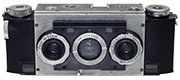
David White, Stereo Realist
After a decline in interest in 3-D photos, which had been so popular until the beginning of the 20th century. This camera made a glorious comeback. Taking advantage of the introduction of color positive film, the Stereo Realist made stereo photography shine again.
–

Arsenal, Kiev
A series of cameras, copies of the Contax, built with machinery, drawings and even parts taken from Dresden to Kiev. It remained in production for decades without any major changes
1948
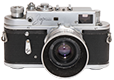
KMZ (Krasnogorsky Mekhanichesky Zavod), Zorki
The first Zorki was a direct copy of the Leica II. Keeping the basic concept, several modifications were made that allowed many photographers, at a fraction of the price of the Leica, to try out a 35mm rangefinder and standard lens mount on the M42.
1949

DFV, Kapsa
Box type produced in Brazil. It uses 120 film and makes the 6x9cm format. The lens is a doublet and the focus can be adjusted by sliding an auxiliary lens in front of it.
–
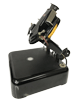
Eastman Kodak, densitometer
An instrument for measuring density point by point, by transmission or reflection. Used, for example, to assess the tonal range of a negative and prepare for enlargement. Used in both black and white and color.
–

Voigtlander Vito II
This camera is well-built and very nice, but it was a late release of a concept that was already quite obsolete at the time.
1950
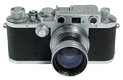
Ernst Leitz, Leica IIIf
The same as the IIIc but now incorporating flash timing. 184,000 Leicas IIIf were produced between 1950 and 1957
–

Eastman Kodak, Dualflex
It’s almost a fake, because it looks like a TLR, Twin Lens Reflex, but it’s actually just a Reflex Brilliant Finder type viewfinder made up of a front lens, a mirror and a magnifying lens on top of the camera.
–

Voigtlander, Prominent
Another experimental design in this 35mm rangefinder with a rangefinder in the viewfinder and coupled to the focus: instead of focusing on the lens barrel itself, the focus is adjusted on a ring on the top of the camera.
–
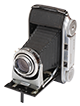
Voigtlander, Bessa II
A 6×9 cm folding camera with a rangefinder in the viewfinder and attached to the focus. Very well built and with a complicated focusing system activated at the top of the camera.
1951

Ihagee, Exa
A simplified version of the Exakta. It has an interesting shutter that uses the mirror mechanism itself, thus eliminating the need for curtains.
–
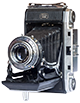
Zeiss Ikon Ikonta 524/2
A 6×9 cm for 120 film with independent rangefinder: after focusing in a separate viewfinder, you have to adjust the distance on the focus ring on the lens.
–
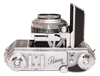
Kodak AG, Retina IIa
Totally different from the Retinas of 1934, the IIa is a much more sophisticated camera with a rangefinder in the viewfinder and coupled to the focus. But still with the leaf-shutter concept in the lens body.
explore
–

Zeiss Ikon, Nettar 518/16
Another 6×6 folding lens. Simple, very well built, but with a worn-out concept of bellows, leaf-shutter and focus by estimation.
1952

Zeiss Ikon, Contessa 35
A drop-bed 35mm folding lens. Excellent build quality, very solid, very compact and a rangefinder attached to the viewfinder.
–

KMZ (Krasnogorsky Mekhanichesky Zavodeiss), Zenit
The first Zenit, manufactured in the USSR, was the Zorki rangefinder, a copy of the Leica, transformed into an SLR. It was designed to be affordable and durable. The model in the collection is more recent.
1953

Zeiss Ikon, Contaflex
Very solid and reliable, this SLR was also successful because of the weight of the brand, since conceptually it didn’t have the features that the future of photography would choose.
1954
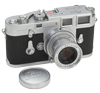
Ernst Leitz, Leica M3
After almost 30 years of the excellent Leica Barnack, comes the giant Leica M3. Considered by many to be the best camera ever built. Extremely versatile, precise and durable.
–
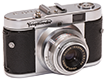
Voigtlander, Vito B
A compact 35mm, very well made and all manual. A camera that was popular and usually came with an excellent optic, the Color-Skopar 50mm.
–

Voigtlander, Vitessa
Unlike anything else, this excellent quality camera didn’t last long. The film advance, the focusing system, the “double door” that opens to let the lens out. Everything is very original in the Vitessa.
–

VEB Carl Zeiss Jena
With its minimalist design, the Werra is a very original camera. The film is advanced using a ring around the lens. Like almost everything from post-war Eastern Europe, it was in production for many years.