year
Chronological circuit, up to 1880
1807
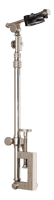
Camera Lucida, William Hyde Wollaston
Conceived as an aid to the draughtsman, the Camera Lucida had a second life with the arrival of photography in 1839. It was used extensively by engraving artists when the illustrated press needed to copy photographs quickly and accurately. The use of the Camera Lucida legitimized the authenticity of the image. This one in the collection was produced by the French firm P. Berville. It is called Chambre Claire in French
1827
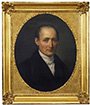
Heliography, Nicephore Niépce
Author of what is considered to be the first photograph in history, the Point de vue du Gras. It was made using a method he called Heliography, curiously, there was no second photograph made using the same method.
explore
1839
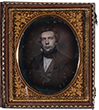
Daguerreotype, Louis Daguerre
Invented by Louis Daguerre, the photographic process called daguerreotype was bought by the French government and given to the world in 1839. It was the first photographic process to achieve success, enormous success.
explore
–
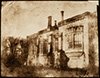
Salted paper, William Henry Fox Talbo,
Before arriving at the complete negative/positive process, Talbot had already developed the salted paper technique for photographic prints. It would later become part of his calotype and also used with other processes such as collodion for printing the positive
explore
–
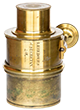
Lens for landscapes, Lerebours et Secretan
The first lenses used in daguerreotypes were of this type, simple achromatic doublets with the diaphragm positioned at the front. This example is an improved design from 1846, manufactured around 1855.
explore
1840
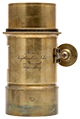
Voigtlander, Petzval’s lens for portraits
Calculated by the mathematician Joseph Petzval shortly after the publication of the Daguerreotype process, this very bright lens, with f/3.6, allowed portraits to be taken. This copy dates from 1862.
explore
1841

Calotype, William Henry Fox Talbot,
In 1841 the paper negative/positive process, which Talbot had been developing since the 1930s, reached an operational level with the same degree of sensitivity as the Daguerreotype. It was the basic process of all analog photography to this day.
explore
1850
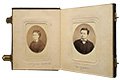
Albumen paper, Louis Désiré Blanquart-Evrard
The printing process using albumen as a base for silver salts was fundamental and practically defined what a photograph would physically be.
explore
1851

Collodion or wet plate, Frederick Scott Archer
Photographic process for glass negatives. It was responsible for the dizzying expansion of photography from 1851 onwards and remained the most widely used process until around 1880.
explore
–
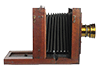
Collodion camera
The great portable camera archetype. With its bellows, clear glass and black cloth, it consolidated the photographic gesture of the first decades.
–

Table for retouching negatives
With the growth of negative/positive processes, the possibility arose of substantially altering the photographic image by retouching the negative before it was printed. This device was the “light table” in the days when electric light didn’t exist or wasn’t available.
explore
–

Contact presses
With the exception of specific applications, all prints from negatives were made by contact. The photograph was the same size as the negative and there was no enlargement.
explore
1855

Ambrotype, James Ambrose Cutting
Direct positive process using collodion on glass to which a black background is applied. From 1855 to 1865 it greatly replaced the Daguerreotype, which was much more expensive and laborious.
explore
–

Landscape lens or objectif simple, Hermagis
Typical design from the early years of photography. Very dark, it has survived for several decades due to the significant increase in sensitivity of new photographic processes.
1856

Cone Centralisateur, Jules Jamin
French variation on the Petzval lens. The cone is designed to reduce internal reflections and improve contrast. The example in the collection bears the Darlot mark, Jamin’s successor, and was manufactured in 1862.
–
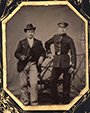
Ferrotype or tintype, Hamilton L. Smith
Process based on collodion but using a tin can painted black as a base. It was by far the cheapest photographic process and was practiced by street photographers for many decades.
explore
1857
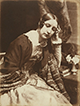
Photography, Elizabeth Eastlake
This seminal article looks at the early history of photography, followed by a discussion of its possible relationship with art.
–

Orthoskop, Voigtlander
Petzval’s drawing, which had been abandoned for almost 20 years, was revived as a lens for landscapes and reproductions. It was considered the best of its time in its category
1859
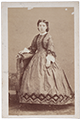
Carte de Visite, André-Adolphe-Eugène Disdéri
With the invention of collodion and albumen paper, there was a fever for these small photos measuring around 6x10cm. Disdéri created the production and mounting process that became a worldwide standard.
explore
1860
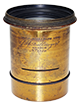
Triple Achromat, Dallmeyer
English novelty, a lens that was practically distortion-free by the standards of the time. It was used to copy Raphael’s drawings.
explore
1865
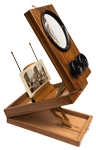
Graphoscope, Charles Gaudin
Accessory for viewing Cartes de Visite, stereoscopes and also the Carte Cabinet format. The large magnifying lens fills the field of vision and produces a much more immersive experience than viewing with the naked eye.
explore
1866

Rapid Rectilinear, Dallmeyer
Revolution in photographic optics. The first general-purpose lens to break portrait or landscape polarization. A reasonable aperture at f/8 and an equally reasonable angle of view of around 50/60º.
–
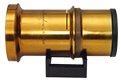
Aplanat, Steinheil
In Munich, at the same time as Dallmeyer launched the Rapid Rectilinear in London, Steinheil launched the Aplanat, with exactly the same concept of two symmetrical doublets.
1870
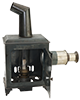
Magic Lantern, Johann Falk
Magic lanterns have existed since 1659, but the invention of photography opened up new possibilities for the projected image that would later bring about cinema.
1871
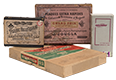
Dry Plates, Richard Maddox
Development of the first photographic emulsions using gelatine as a suspension medium. Paved the way for industrial production to replace the handmade production of photographic media.
1877

Euryscope, Hans Zincke Sommer
It took 10 years for pioneer Voigtlander to launch its aplanat. The Euryscope series was the salvation of the company that insisted on living off the former success of Petzval. The reason: family feuds.